I thought I'd point out a link to the Minelab GP 3500 review I wrote for the September issue of Lost Treasure magazine. They have it on their website (edit Dec 2018 - Lost Treasure magazine is out of business and link is gone) for those of you that may have missed it. One thing I made a point of doing in the article is trying to get people to consider the Minelab GP 3500 as much more than just a "nugget detector". The fact is that it is one of the most powerful metal detectors available today, and can hit coins, jewelry, relics, and yes, nuggets, deeper than most metal detectors. Since it is a pulse induction (PI) detector, it has a relatively limited ability to discriminate targets. That said, by learning the tones the machine puts out and using the iron discrimination circuit you get more ability to read targets than is the case with most PI detectors.
I've been experimenting with my GP 3500 as a coin and jewelry detector. The short story is it easily hits targets deeper than the best VLF detectors. Yes, you dig more junk, but the biggest limiting factor may be that the unit is TOO powerful. You can only dig holes so deep in public places, and so many parks and other groomed areas are in effect off-limits to the GP 3500 as digging holes over a foot deep in not an option in many parks. But for beach use and relic or coin detecting in areas where digging extra deep is allowable, the GP 3500 is certain to pull up finds people with VLF machines are leaving behind.
The GP 3500 control box is protected with a Coiltek neoprene cover. I have a half-size Minelab battery tied to the side of the unit in its own Minelab battery belt pouch. Another option are the new Pocket Rocket Lithium Ion batteries. The battery is connected to the control box with a Coiltek short power cable, the one Coiltek sells for use as a charging cable instead of using the 3 foot Minelab cable.
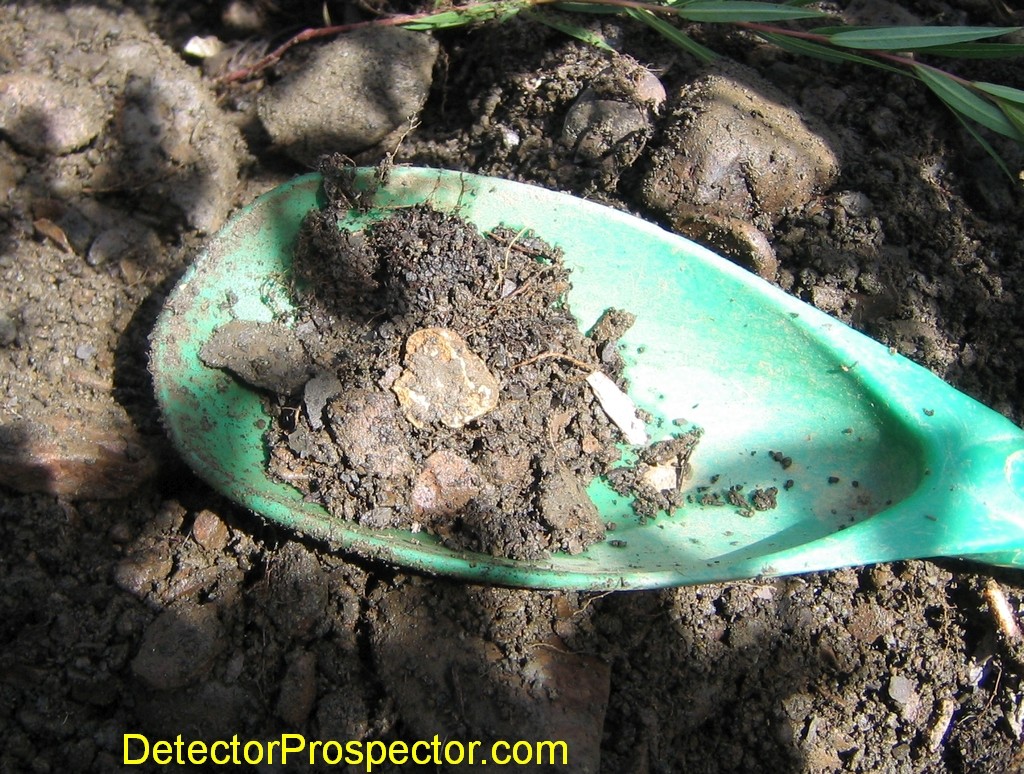
6.8 pennyweight gold nugget found with Minelab GP 3500
This setup allows me to set the detector down and dig without being attached to the machine by a normal backpack mounted battery and cable setup. The half-size battery is fine for more hours of coin detecting than I'd normally ever undertake in a day. And the whole setup is not so heavy that I cannot handle it for long hours. I plan to use it for nugget detecting in brushy areas next summer or for some "dig and detect" sessions where the machine spends more time on the ground than on my arm.
I'm using the Coiltek 14" mono coil which seems to work well for the coin detecting. The stock 11" coil is ok but is a bit too sensitive to tiny surface trash the larger coil tends to ignore. Being a mono coil the 14" has terrific depth for its size, but I have given up the ability to use the GP iron discrimination circuit. I'm going by the tones only (the review describes this in detail), but I'm looking at a mid-sized DD coil for this use to get back that extra discrimination ability. This would help eliminate a few of the iron targets I'm currently digging.
The headphones are the DetectorPro Uniprobe combination headphone/PI pinpointer setup that is a must for this type of detecting. The Uniprobe pinpointers are easily the most powerful I have used, in that they are a full-fledged pulse induction metal detector with a probe attached instead of a coil. In fact, there is an optional 11" coil and handle assembly available to convert the Uniprobe into a great little PI detector. Normally with a GP 3500 you just dig a huge hole while nugget detecting. But for coin and jewelry detecting better pinpointing skills must be developed, and the use of a good pinpointer is a real requirement. I highly recommend the Uniprobe pinpointers. The headphone model is mounted in a set of Gray Ghost headphones, which works great for me as I am a headphone addict. DetectorPro makes a Pocket Uniprobe that has a speaker but I cannot hear it very well with headphones on. Plus, it is just another gadget to carry. I tried the Pocket Uniprobe and decided having it all in one unit works better for me.
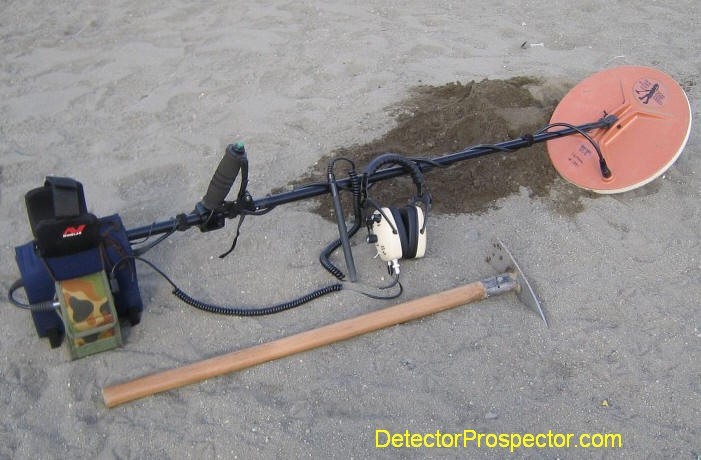
Minelab GP 3500 rigged up to hunt without using harness and bungee setup
The final item in the picture is my digging pick. I do not like the short handles that are standard on most picks. I got a 36" hickory sledge hammer handle and replaced the stock handle, although I can switch it back as both handles mount with a single bolt to the head. I like these long-handle picks as I use them as a walking stick (great for side-hilling at Moore Creek!), and I have to bend over less when I dig. There is, of course, a super magnet attached to the head of the pick for sucking up small iron trash.
The only other items I am using that are not in the picture are my nylon belt and large trash/treasure pouch and plastic scoop. The scoop is great for getting deeper into the bottom of the holes I dig, and for locating some small items as would be done in nugget detecting. All trash goes in the pouch for later disposal.
I know these detectors are expensive, but if you have a serious need to get some REAL extra depth, you need to look hard at the Minelab GP 3500. These things would be awesome for hunting Civil War relics in a "worked out" location.
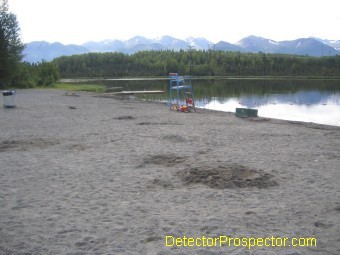
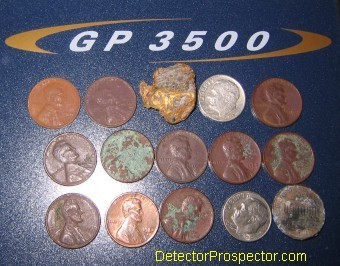
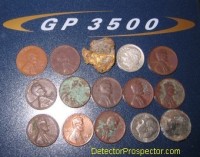
Goose lake, Alaska plus gold nugget and old coins found with GP 3500
Two last hints. Carry a VLF detector along, and check the targets the GP 3500 finds for you. In some cases the target will be shallow enough you can save a little digging. But better yet, if you get no signal at all from your VLF unit, you'll know you have a deep target. You will be surprised how many of these there are that a VLF unit just will not hit. I'm afraid once you experience this for awhile you will tend to lose a certain amount of faith in your VLF detector. Yes, you are missing targets. LOTS of them.
But the second hint is the best. Take the GP 3500 to a once good place, but one that has been hunted so much that there are no targets left using a VLF detector. I am sure that you will end up like me, simply amazed at how all of the sudden the place seems like it has never had a detector over it, there are so many targets. Better yet, all the shallow stuff should be gone, with only the deepest finds, and therefore some of the best, remaining for you!
~ Steve Herschbach
Copyright © 2005 Herschbach Enterprises
-
 1
1