After returning from Moore Creek in July I put the word out that I was looking for Honda 200 three-wheelers. I was offered one in good condition and bought it, plus another one not running that I purchased for parts. My father came up with a Honda 110 that a friend gave him. Our little fleet was growing. I wanted to make sure that for our assault on the old bulldozer we had plenty of ability to transport people and tools the three miles over the mountain to where the unit was stuck in a bog.
When we acquired Moore Creek some of the equipment we got was actually over the mountain at another creek named Deadwood Creek. In fact, that other location was where the bulldozer was coming from when it got stuck three miles out from our camp. There was another Honda 200 ATV over at that far camp, and so my father and I decided to fly up to Moore Creek, drop off one of our just purchased Hondas, and then fly over the hill and get that three-wheeler.
This proved to be a true Alaska Bush pilot adventure. I’ve flown around Alaska with my father for 40 years now and we have seen some pretty exciting moments in that time. But in recent years usually the flying is uneventful and even downright boring. Every once in awhile though you tackle some new airstrip in a remote location and things can get very interesting, to say the least. This proved to be one of those times.
We crammed a Honda 200 3-wheeler into the Cessna 206 and flew it into Moore Creek. No big deal there. My father had checked out the Deadwood Creek airstrip previously when we had a friend up to Moore Creek with a Super Cub. He figured he could put the 206 in and so we went for it. The strip is dozed over the curve of a hill and grown up with brush. It is always something to be making a landing for the first time on a strip like that, and this was no exception. We hit the ground going uphill, and then had to skid to the left to stay on what appeared to be the best route. You roll up over the crest and down the other side, so forward visibility is limited. We made it but it was one of the more exciting landings I've made with him in some time.

Airstrip at Deadwood Creek, Alaska over the hill from Moore Creek
We explored a bit, and then loaded up the Honda 200 three-wheeler to take over to Moore Creek. The unit appeared to have real low hours but had been sitting in the weather for years. Two tires were flat, and although it would turn over the fuel tank was full of rust and it would not start. Then came the fun part... takeoff. A Cessna 206 with two guys and gear is iffy on this strip. We ran flagging over the hill so we would know which way to go since we could not see over the crest of the hill. Not only does the strip run over the hill but it is not straight. We had to spend an hour breaking brush and even tall grass as it slows you down plowing through it. We rolled the plane on down to the lower end of the strip, which meant a takeoff run up a pretty good slope, leveling at the top, then hopefully getting off the ground as we rolled down the other side.
We had a preference for one direction as there are ridges to clear both ways, but the one way the ridge is farther away. Plus, if we had to abort the crash zone was smoother that way. We would run into downhill sloping brush as opposed to falling into a small valley the other way. No, I'm not kidding, you plan your crash... just in case. Only problem was a tacking tailwind going that way. So we parked and waited a half hour watching a piece of flagging tied in a tree. It finally hung down straight indicating a lull in the breeze, and we went for it.
After all the suspense, we got off with no problem. That, my friends, is what it is like flying small planes in Bush strips in Alaska. This scenario may sound insane to some but it is what you have to do to be able to see and operate in the vast 99% of Alaska that nobody else ever sees. You have to be willing to land on beaches and ridges and marginal airstrips just barely carved out of the wilderness. The secret to success is an old Alaska Bush pilot saying - “There are old pilots and bold pilots but no old bold pilots”. You have to know when to go for it, and when to just give it up and go back home. And dear old Dad has proven he knows how and when to make those calls.
The stage was set for the next attempt to get the old bulldozer back into camp. However, before I would return to Moore Creek I planned on making one last nugget hunt at Ganes Creek. This trip was prompted by Steve Burris finding an incredible 33.85 oz nugget at Ganes in June 2004, right on top of the ground in an area heavily hunted by others in the past, including myself. It was the largest nugget found at Ganes with a detector up until that point, and highlighted just how easy it is to miss nuggets when dealing with an area the size of Ganes Creek. Seeing a picture of the nugget gave me a case of gold fever, and the desire to give Ganes just one more try.
I put the word out I was planning a trip to Ganes Creek, and in short order a group of people signed up to go the same week. Half were local people I know, and the other half were visitors from down south, mostly from Arizona and Nevada. Some of these I knew by reputation and the internet to be knowledgeable nugget hunters and so it had the makings of an interesting week. I planned on meeting my father in McGrath as the group left Ganes Creek and going straight over to Moore Creek rather than returning to Anchorage.
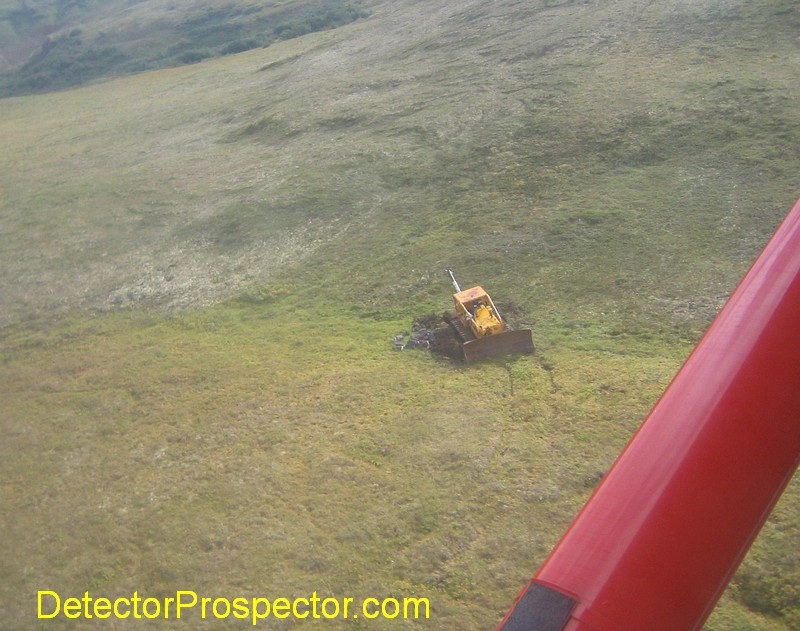
The stuck D9 bulldozer
The Ganes Creek trip is a long story in itself, but one I’ll leave for another time. The short story is that we had delays getting both into Ganes Creek and out due to the smoke from the many forest fires in Alaska that summer. It also became apparent that the years and number of hunters at Ganes Creek have had an effect on the chances of finding nuggets at Ganes Creek. I actually was very pleased with the nuggets I found, but the fact is that most of the visitors from the Lower 48 had pretty poor luck finding gold. In the early days most anyone swinging a detector at Ganes Creek could find a nugget, but at this point I think only the very experienced or very lucky will be finding nuggets in the future at Ganes Creek. It also was obvious that nugget detecting experience elsewhere does not prepare people for nugget hunting tailing piles in Alaska. It is a different game, and requires a different set of skills. Some of the guys from down south were not too happy with their finds… or lack thereof… for the week.
While I found some nice nuggets and had a good week at Ganes Creek, it was with a certain amount of relief that I found myself watching the rest of the group get on the plane in McGrath and head back to civilization. I count among some of the very best times of my life those times when I have been totally on my own in remote locations of Alaska. There is something enlivening about being totally dependent on ones self and the knowledge that there is nobody to bail you out if something goes wrong.
So now what? The smoke from the forest fires prevented my father from making it over the Alaska Range to McGrath to pick me up for the trip to Moore Creek. It was morning still, and I faced the prospect of checking into a hotel and waiting it out. By the time I got supper and breakfast I’d be looking at a $100 bill.
The smoke was thick in the area but had lifted since early morning, and it looked flyable to me. So I wandered over to Magnuson Air and asked Lucky if he thought he could get me to Moore Creek. It costs $250 one way to the mine from McGrath but I figured I’d be getting a $100 discount by not staying in McGrath. Plus, I’d be able to get to work at the mine instead of just killing time. Lucky figured we could make it to Moore Creek, and so I loaded my gear up into the Magnuson 206 and we headed for the mine.
It was actually a nice, sunny day despite the smoke, and the smoke thinned as we got to Moore Creek. We landed at the mine, and then Lucky took off to head back to McGrath. I opened up the camp and did odds and ends work waiting for my father and cousin Bob to arrive. I hung around camp a bit the next morning half expecting them to show up, and was just getting ready to go up and clear trail when they did finally arrive. They had a tale of wandering mountain passes in thick smoke trying to find a way over the Alaska Range that sounded not a bit fun, so I was glad they had made it to the mine safe and sound.
We cleared the last bit of trail to the top of the mountain and so were finally able to drive our three-wheelers all the way to the bulldozer. The trail is actually an existing bulldozer route that has grown up over the years and so along some portions is actually like an old road in the lower elevations but fades to a bare trail above tree line. Once you get above tree line the ridges are rounded and smooth and so it is pretty easy to get around on an ATV.
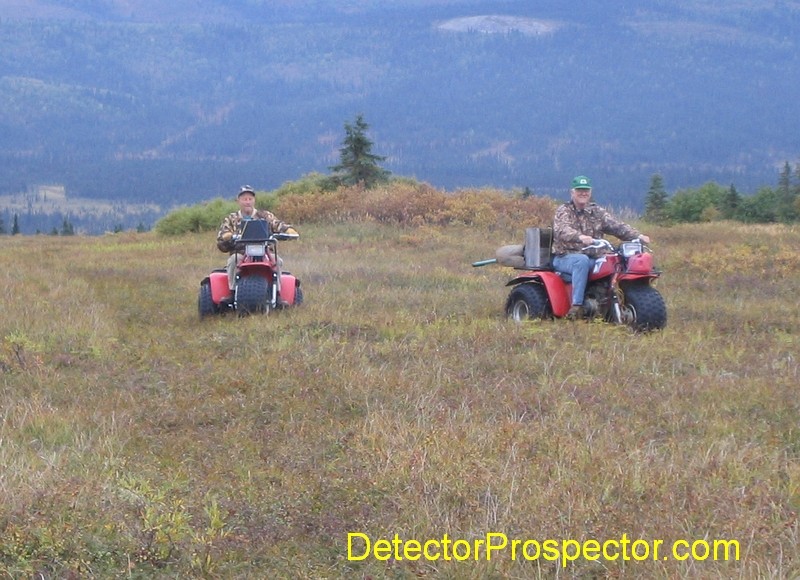
Using Honda 3-wheelers to run supplies over hill to stuck D9 bulldozer
We took a dual approach to getting the bulldozer unstuck. A combination of trying to dig it out and trying to get the old beast started up. The D9 is a 1950’s era model that uses a small gasoline motor referred to as a “pony motor” for a starter. So first step was to try and get the pony motor started. It uses a 6V car type battery and so we used the ATVs to haul up a battery plus some fresh gas. The first thing we discovered was that the small exhaust pipe sticking straight up out of the top of the dozer had not been covered, and when we cranked the pony motor over water puked up out of the exhaust pipe! We drained what we could, and then ran the battery dead trying to clear water out of the system. The battery did not last any time at all, actually. The old starter motor seemed to just suck it dead in very little time. We spent the rest of the day digging away at the lower rear track where it was sunk in the mud.
If we could get the motor running, we could hopefully use the rear ripper hydraulics to push down and lift the rear of the dozer up, so that logs could be stuffed under the tracks. But since we had more people than we really needed digging seemed to be another approach to take while also keeping busy. The old bulldozer has a cable lift blade in front, which unfortunately cannot be used to do the same thing up front. It can only lift, not push down.
We headed back to camp eventually and put the battery on a charger overnight. Dad and Bob decided to fly over to one of the nearby mines to borrow a jack and returned with a loaned 40 ton jack. Then back up to the dozer for more digging and work. We got the rear corner of the dozer dug out far enough to get the jack under it and this started an effort of putting rocks and timbers under the jack and driving them down into the muck until a solid base was created. It took a lot of work to finally get the rear of the dozer to lift a couple inches. And with that accomplished, we stuck timbers under the rear of the track, which when the jack was let down just sunk into the muck. Over and over we jacked the unit up, stuffed timbers and rocks under the track, and let it down to all sink right back to where we started.
We got the pony motor clear of water but it still would not start before the battery ran dead. And finally after a couple days we ran out of time and had to return to Anchorage.
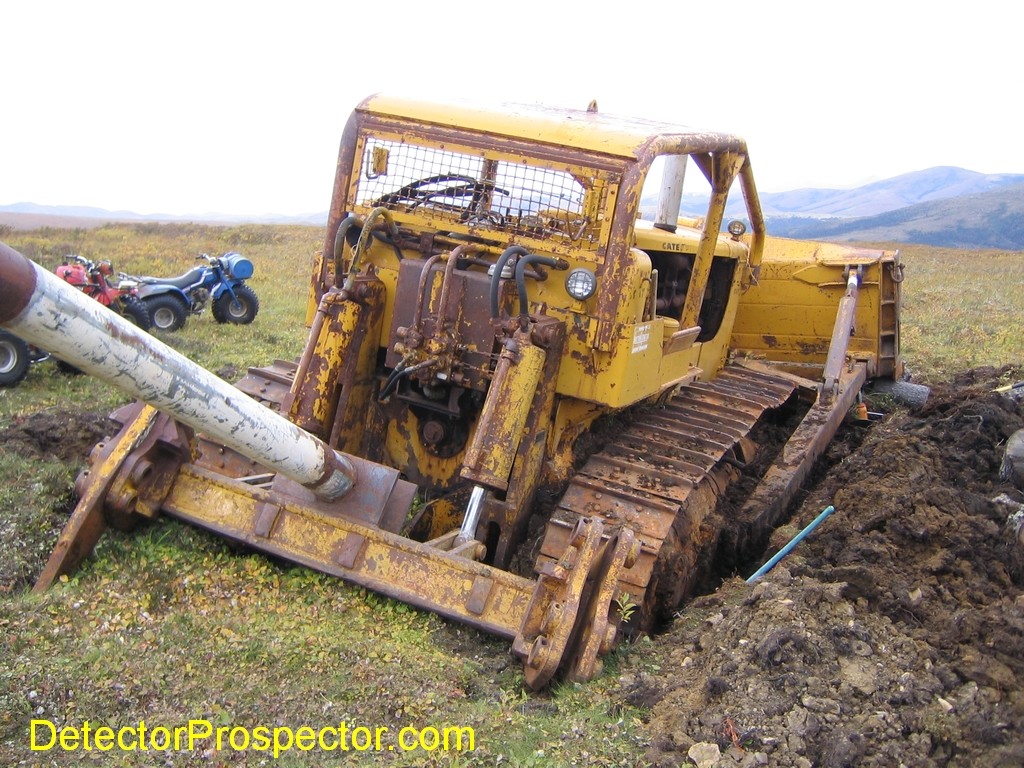
Lots of digging, lots of work with hydraulic jacks and log sections
This time I returned with my other partner John, along with more batteries as the single battery was not giving us any life before it ran dead, and having to return to camp to charge it overnight was taking too much time. Plus a new jack. I found there was no spark on the pony motor, and so I pulled off the magneto, cleaned up the points, and put it back together. And Pow, Pop, Pop, Pow! Smoke came out and more water came from somewhere and got the plugs wet but at least we had fire! But we ran the batteries dead without the motor actually starting. We spent more time digging, and more time pulling every part of the pony motor apart we could trying to get it to start. It would pop and backfire and do everything but actually run. Finally we gave up and once again we had to return to Anchorage, frustrated by our inability to get the motor running. The dozer was now so dug out that it would most likely drive out of the hole, if only we could get it running. The fall colors were out in full, and winter was coming fast. We needed to do something soon or winter would put things off for another season.
I got a hold of my old friend Tom, who has worked with heavy equipment for many years. He is a very busy person, but he agreed to come up and try and figure out what was up with the pony motor. I was stymied at this point, and was worried about the delay. Overland permits for bulldozer travel off claim blocks can generally only be had in the winter months. The ground is softer in the warmer months and so travel when the ground is frozen protects the ground. If we could not get the dozer running before winter set in, we would most likely lose an entire season. The main limitation in the permits is the requirement that the ground have snow cover. We needed to get the bulldozer onto the claims while the ground was still frozen.
Tom, my father, and I returned to the mine for one last try in early October. The snow could fly at any moment, and we not only wanted to try and get the bulldozer running, but also wanted to stake some more mining claims. We had our hands full, and this was likely to be the last chance with the bulldozer for the season.
We made it to the mine, and settled in for the evening. And awoke the next morning to snow and thick fog. It was only a dusting of snow, but it covered the ground just enough to hide the trail to the bulldozer. Add in the heavy fog, and we were soon basically lost up on top of the mountain trying to find our way to the bulldozer. Luckily I had used my GPS on the previous visit to trace the trail. Even so, what the GPS said argued heavily with what our eyes were seeing. Were it not for the GPS I have doubts we would ever have found the bulldozer that day.
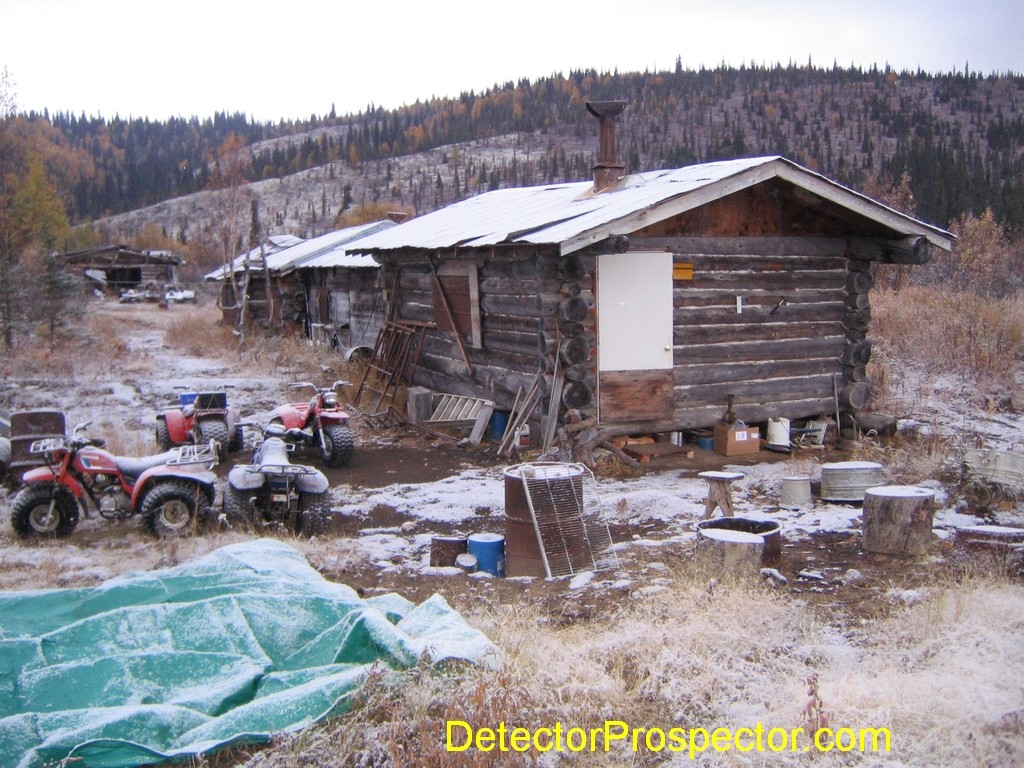
Winter is coming - fresh snow at Moore camp
But find it we did, and Tom proceeded to try and figure out why the pony motor would not start. We had over time eliminated almost every possibility, and when you get right down to it these old motors really are not very complicated. You need fuel, compression, and spark. The only thing that seemed weird was all the backfiring and that the carb would want to blow out backwards instead of pulling air.
There simply seemed to be no options left, when I thought back on my previous work on the motor. Early on I had pulled the magneto apart to clean the points. Did I maybe not put it back together correctly? It is a simple thing to disassemble, but if you are not careful you can put it back together 180 degrees out of where it came apart. I wondered about this for awhile, and finally piped up with “you know, maybe I put the magneto back together backwards”.
So we pulled the magneto off, rotated it 180 degrees, and put it back together. Tom got on the dozer, turned the pony motor over… and it fired right up! I felt a very strange combination of embarrassment at having been the cause of a lot of extra work, and happiness at having finally figured out what the problem was.
Tom let the pony motor run a bit, and after a rough start it smoothed out and sounded just great, albeit loud as heck. Kind of like listening to a shotgun firing 3600 times per minute. Then he engaged the clutch to the main motor, and smoke puffed out the big stack. And puffed, and puffed, and then all the sudden our bulldozer was running!
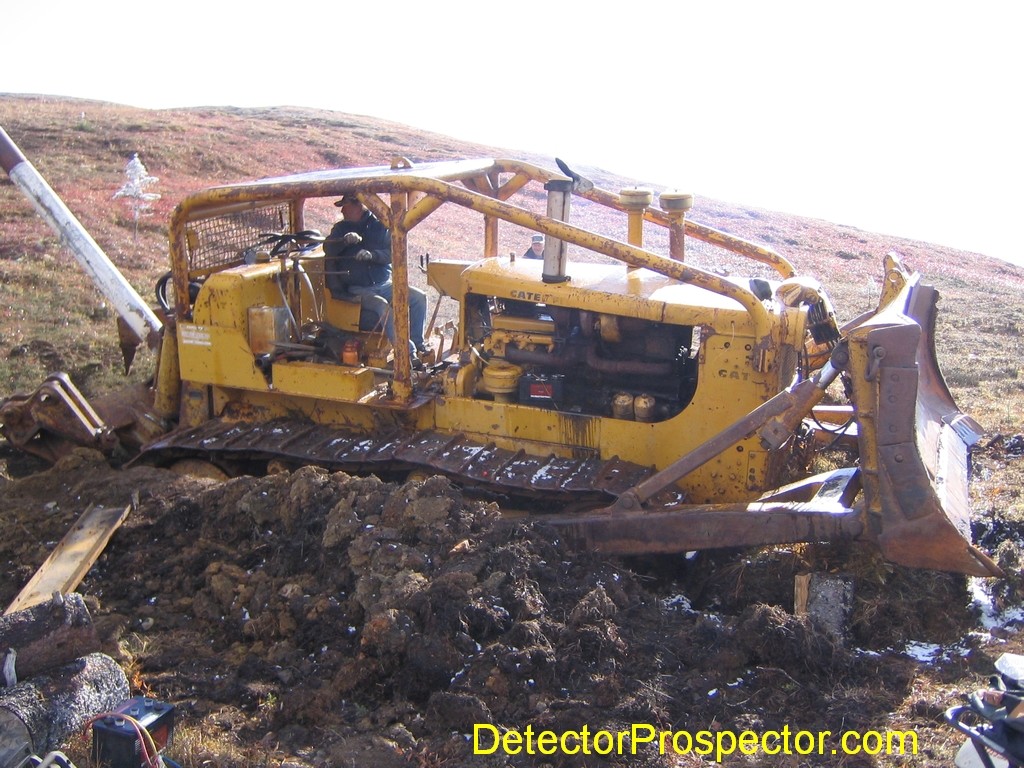
Smoke coming out of the stack - the D9 starts!!
What an incredible moment! The main engine really sounded good, and Tom let it warm up for some time. Then he gave a pull on a lever, and the blade lifted. We have a ripper unit on the back of the dozer, and had filled the tank with fresh hydraulic fluid. Tom pulled another lever, and the ripper blade lifted up.
Dad and I got all the remaining timbers we had and laid out a parking pad just ahead of the dozer on level ground. We had just enough logs to cover two track lengths. Then the moment of truth arrived, Tom pulled more levers and the bulldozer drove out of the hole.
Whoops and yells and handshakes all around ensued. Tom parked the bulldozer on our logs, and powered her down. We drained and covered everything to the best of our ability for the winter ahead, and left the dozer for the next spring. It was amazing how everything finally happened in so short a period of time, but it was all the hours of preparatory work that made it all seem so easy at the end.
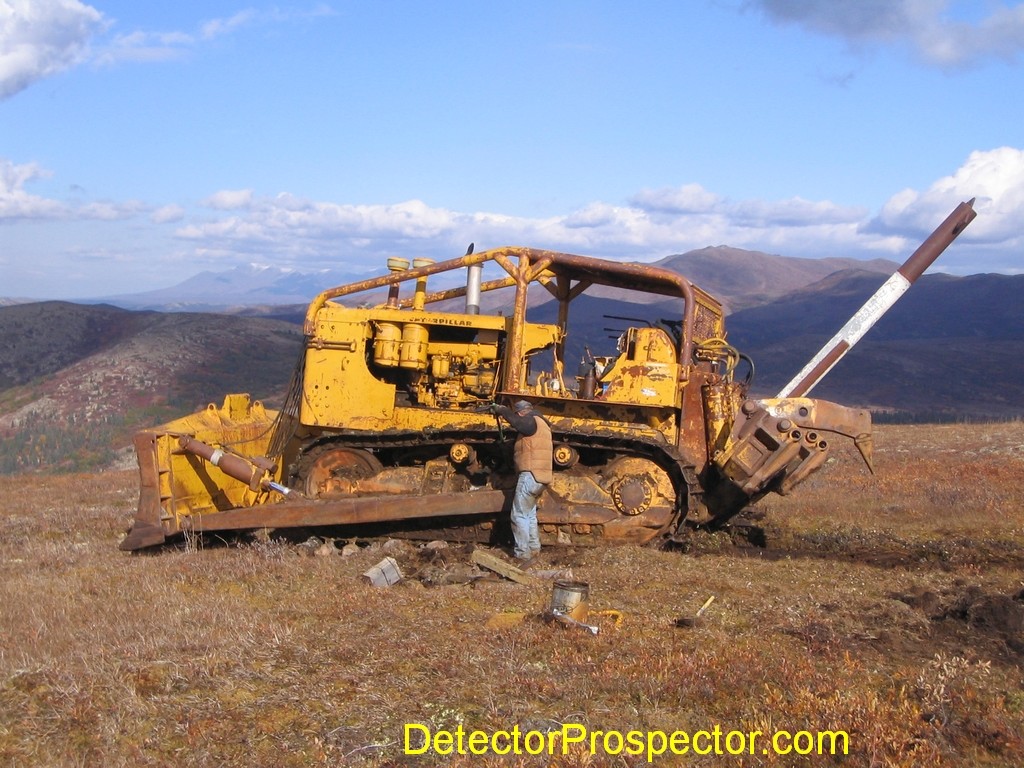
Dozer up and out of the hole, ready to drive to Moore Creek next spring
We did our claim staking, and closed up the camp for winter. The year 2004 at Moore Creek came to an end, and the snows of winter came shortly after we left the mine. Success could not have come any later that year.
Events slowed, but I did get an Overland Permit lined up in anticipation of moving the bulldozer into camp in the spring of 2005. Travel within a claim block is covered under our mining permits, but since the bulldozer was off the claims we needed a permit to bring it into camp. The main limitation was that overland movement had to be while the ground was frozen and covered with snow, and so we were aiming for an early spring operation.
We were planning for April, but the winter of 2004-2005 proved to be one of the heaviest snow years on record. Dad and I flew up to the mine in April, but the dozer had snow drifted over the seat. It was still too early, and so we took advantage of the snow, and asked our friend Mike to fly a load of gear up to the dozer with his Super Cub, which was on skies for the winter. He landed on the hill by the dozer, and left a battery, propane tanks, a heater, and tarps plus some miscellaneous gear. Dad and I planned on flying into Moore Creek just before the snow melted, and so getting that gear to the dozer would have meant lots of snowshoeing. Now we were set.
We monitored the snow situation, and finally flew up in early May in my brother-in-laws Citabria. Our original permit expired the end of April but I was able to get a two week extension due to the extreme snow conditions. There was still a few feet of snow on the ground in places but in most areas there was less than a couple feet. We made some passes over the bulldozer, and I launched sleeping bags and some basic camping supplies out of the plane. I’ve done some of these “bombing runs” before and they are actually kind of fun. Dad does all the work, however. I just hold stuff out the door until he yells “Go”! and I let go of it. With any luck it lands halfway close to the target.
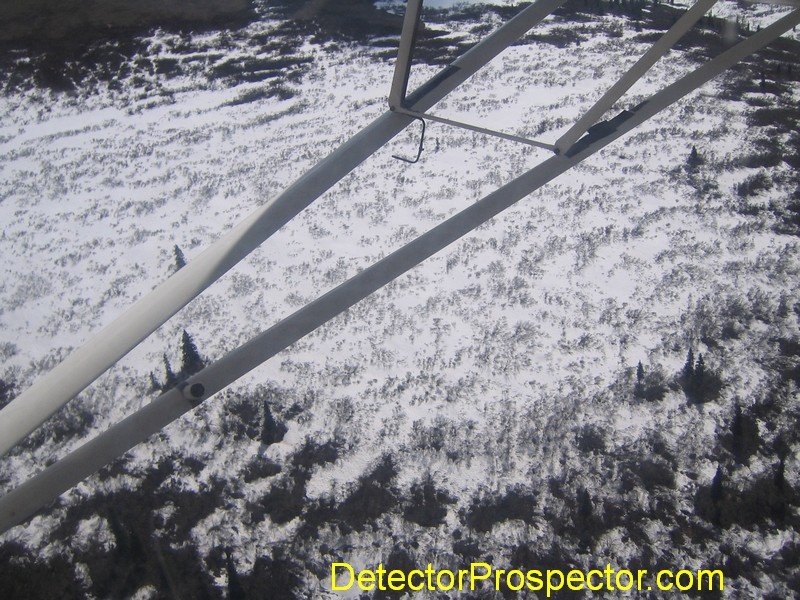
Aerial view from Citabria of snow in the hills in early 2005
We landed at Moore Creek, and hiked up to the dozer on snowshoes. We planned on camping the night, and heating the motor overnight, but it was rather warm (relatively speaking) when we got to the dozer so we went ahead and tried to start her. And amazingly, it fired right up!
I had been studying my D9 bulldozer manuals, but the fact is I have never driven anything even close to one of these monsters. I really had no true idea what I was doing, but just followed the manuals. That worked well enough in getting the unit started, but finally after warming her up I had to make the big move. We loaded up all the tools, batteries and other gear. I held my breath, put it in gear, and engaged the clutch. The next thing I knew I was driving a D9 bulldozer up a mountainside.
I had been warned that no matter how big these things seem, driving into too deep of snow conditions could get you high-centered in short order. The snow was only a foot or two deep, but I could not tell really how deep it was, except for my what seemed like endless trips over the trail on the three-wheelers the previous fall. I just kept her going slow and forged ahead, and after a bit it actually seemed pretty easy. Dad and I both had grins on our faces as well drove along, with all the overnight gear we had pre-staged loaded on the bulldozer unused.
Up the hill I went, and down the other side. Basically just a drive over the hill, and I got to being lulled into how easy it all was. Finally we were on our claims, and camp was only minutes away. I was on cruise control, just enjoying the ride. And then the dozer broke through the crust and muck started churning! Only a heartbeat seemed to pass, but next thing I knew we had come to a stop in the middle of the trail. Apparently the low flat bog areas which we were passing through just before arriving at camp had thawed under the snow. The only good news was that it was still frozen a short distance below, but the dozer was spinning on the frozen muck and could gain no traction to get up and out of the hole we were in.
Still, we had made it 99% of the way into camp, and so could not feel all that bad about the situation. It was only a 10-15 minute hike to camp, and we got a good nights sleep. Then up and back to the dozer the next morning, to get out of our little situation. We took chains, cables, and clamps for camp with us, and a chainsaw. We cleared a bunch of alders ahead of the dozer and laid them down in front of it to make an exit pad. The we cut a big dead spruce and levered it over in front of the tracks with a long pry bar. We took cables and ran then through the tracks and around the log. I fired up the dozer, and when I engaged the clutch the front end climbed up on the log and what seemed an incredible angle. I half closed my eyes, and the front end came up out of the hole, and fell over out and onto the alder pile ahead of the log. We were unstuck and on the first try.
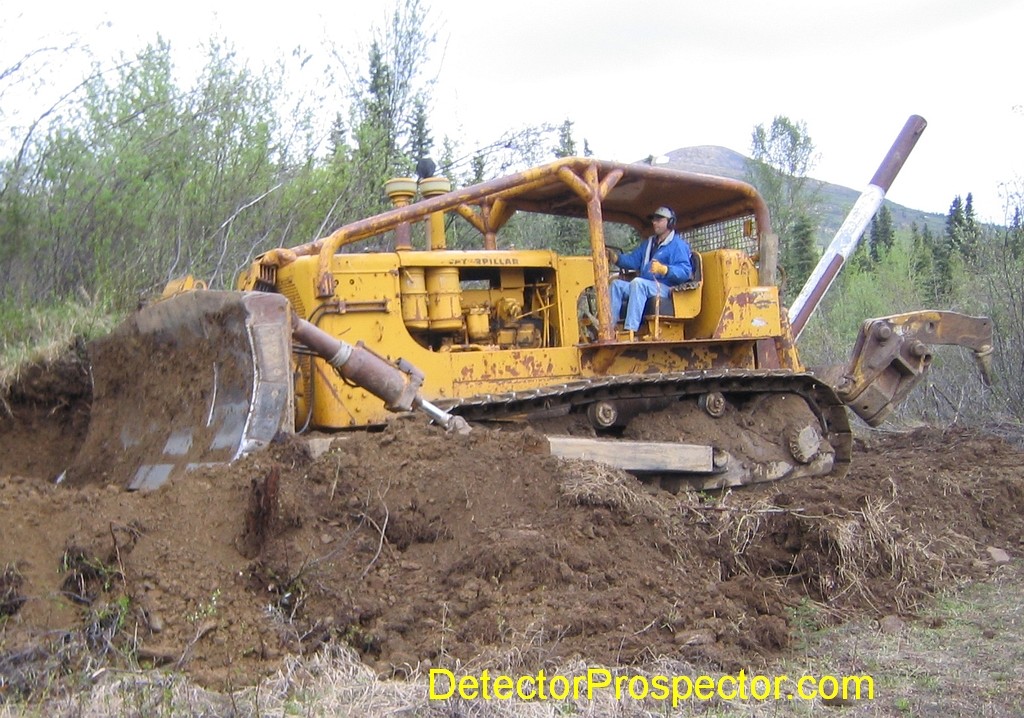
Project a year in the making - D9 finally back at Moore Creek and Steve clearing airstrip
I now was much more cautious heading into camp, as my inattention the day before had got us stuck. If it even threatened to get soft ahead, I drove over the alders next to the trail, which created a natural pad. The next thing I knew I was driving the bulldozer into camp, and when I finally parked it and got off it was one of the happiest days of my life. I literally wanted to kiss the ground! Dad and I hugged and shook hands and slapped each other on the back. In all our years I do not think we have tackled a project that took so long and so much effort as moving this D9 bulldozer into Moore Creek camp. And like all things difficult to achieve, the final success was all that much more satisfying. In all the excitement I forget to take any pictures, but here is a shot of the old girl back in camp later in the year, with me working on clearing and extending the runway.
I have to finish this tale by thanking Bob, John, Tom, Doug, Mike, and most of all my father, Bud Herschbach, for all their hard work and contributions towards getting our bulldozer back to camp. There is no way I could have done it without them. Thanks guys!
~ Steve Herschbach
Copyright © 2005 Herschbach Enterprises
-
 3
3