
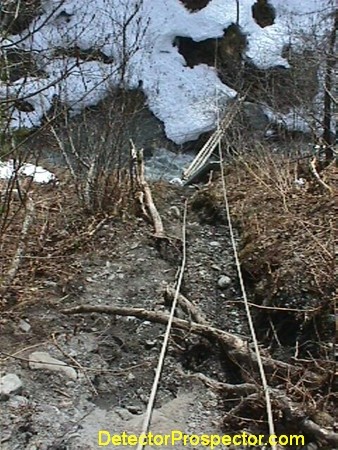
The problem with packing dredging equipment into a canyon is that someday you must pack it out again. I spent a good deal of Saturday and Sunday doing just that. The dredge had to be packed piece by piece up the creek to a log footbridge. There is a 100 foot climb up a rope above the footbridge, and then a short walk to the base of another steep hill. The distance is not too far, it is just kind of vertical! The photo above was taken during one of the previous weekends, so the snow is now gone. This kind of access is the main reason why I prefer the twin 5.5HP pumps on my dredge. I'd rather make two relatively easy trips, than one heavier and more dangerous trip with a large motor.
After retrieving most of the equipment, I wanted to get in some nugget detecting. I decided to try and find some new detecting sites, as the previous weekend proved the old sites are getting a bit lean on gold. I have had my best luck detecting at Crow Creek Mine by following the surface of the old hydraulic workings. The old miners used pipes to bring water from a considerable distance upstream. This water was directed through large nozzles (giants) which were used to wash vast amounts of material through the sluicing system. The mine is actually an artificial valley, about 250 feet deep, created by the old mining operations.
Looking down into Crow Creek canyon
As the water and material was washed into the sluice boxes, gold settled into the surface of the material below. Much of the old Crow Creek operation never reached bedrock; the gravels were washed in a v-shaped cut into the sluice boxes. When they stopped mining, much of the gold was left in depressions and pockets in the surface of the mining cuts.
A lot of this remaining virgin material, with its enriched surface layer of gold, can be found today, but it usually requires a bit of work. Worthless material caved onto much of the virgin ground, and later mining covered much in tailings. Finally, the area has grown a thick layer of brush, which obscures the terrain during most of the summer. Early spring is the best time to prospect for new sites at Crow Creek, before the lush vegetation sprouts up.
I chose to use a Fisher Gold Bug 2 on this trip. While this is an older manual tuning design I am familiar with it and in the hands of a person who knows how to tune it the Gold Bug 2 can hit some very small gold. I have no problem in low mineral ground finding tiny pieces weighing a tenth of a grain or less (480 grains per ounce). I spent some time prospecting the tops of some steep slopes, but only found a few buckshot. I proceeded upstream, when a small bank of brown gravel along a side gully caught my eye. The main gold-bearing material at Crow Creek is a clay-rich yellow-brown color that is easily distinguished from the washed gray tailings. The tailings material is also very loose, while the virgin material is very compact and can require a pick to loosen at times. The picture above shows the gray tailings on top of the brown virgin layer. The boundary, where the gray meets the brown, is most often a very productive layer.
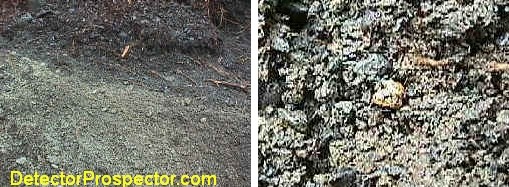
Gray tailings over brown virgin material & small nugget on layer
The tailings tend to have a lot of iron and other trash, and not much gold, so I rake it away from the brown layer. The detector is used to carefully check the surface of the brown layer for nuggets. The nuggets are often found around rocks lodged in the surface of the brown material. A few more scrapes off the surface, and a double-check with the detector, and then more tailings must be removed. In some areas, the virgin material can be very rich, and so I always work into it a small distance to check. Many times it is unproductive compared to the rich boundary area, so I just follow the layer along.
The ground at Crow Creek has very little iron mineralization, and high frequency detectors like the Fisher Gold Bug 2 and White's Goldmasters really shine here. They can be used at full sensitivity levels with no problem, and it will hit incredibly small gold, even with the standard 10" elliptical coil, although to really get the edge go to the smaller 6" elliptical coils. After several hours of scraping and detecting with the Gold Bug 2 I came up with 28 nuggets. The area looks good for more, and you can bet I'll be back in the future!
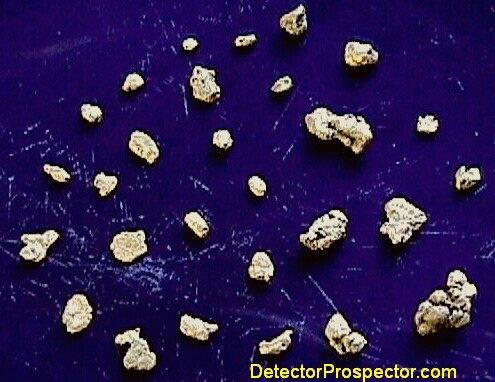
Steve's nuggets for the day
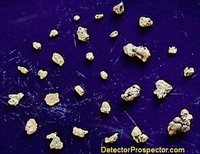
The largest nugget, in the lower right hand corner, weighs 6 grains. The smallest is about 1/10th grain. The total weight is 41.7 grains, or 1.7 pennyweight. The number of nuggets is encouraging, but the small size is keeping the weight down. Still, a vast improvement over the last couple of weekends.
~ Steve Herschbach
Copyright © 2000 Herschbach Enterprises