Well, I'm back from 8 days at Moore Creek. It was a great trip, and one from which I have returned with a certain feeling of relief. The fact is that I got myself and my partners into this property based on my knowledge of the ground from old reports and previous visits. But until now all the gold I've ever found at Moore Creek amounts to about an ounce. Everything in the old records told me the gold should be there, but we had just not had much luck finding anything significant. But I've also not spent much time trying.
My father flew out with my cousin Bob and I flew out with our friend Mike. We had lots of other stuff to do while out there this week. We staked some more claims, cleared brush... even put up a real windsock on the runway! We also did some test work panning, highbanking, and a little dredging. But I finally did make time to do plenty of detecting this trip.
The result was more gold than I've ever found in a week before. Just over 23 ounces of chunky nuggets - almost two Troy pounds of gold! My fear that just maybe the old-timers had done a better job than I thought have now been relieved.
I can attribute the success in no small part to my Minelab GP 3000. I've used the Minelabs for a few years, but had never found the spot to really clean up with one. Either the gold would be too small, like around Anchorage, or way too much trash, like at Ganes Creek. I did have some success in the Fortymile but did not get into those multi-ounce nuggets that really add up.

Old mine tailings and pond at Moore Creek, Alaska
At Moore Creek I've finally found a place where my Minelab really sings. Good sized gold, minimal trash (except a few areas), and ground VLF detectors do poorly on. The bedrock and ground matrix is a fairly neutral shale rock. But mixed with the shale are both very positive and very negative hot rocks. A combination that generates a tremendous amount of noise from a VLF detector.
The only way machines like the my Fisher Gold Bug 2 or my father's Tesoro Lobo would work quietly would be to use the iron id modes. This would more or less eliminate the false signals from the rocks. But any gold under or very near the rocks would be lost and performance is not what it could be.
I ran my GP 3000 with the Coiltek 12"x24" mono coil, giving me a double edge. Not only does the Minelab ignore and see through the various hot rocks, the big coil covers more ground and gets better depth on large nuggets than smaller coils. The GP 3000 is not an inexpensive machine, but I paid for it several times over last week. It will be getting a lot more use at Moore Creek in the future.
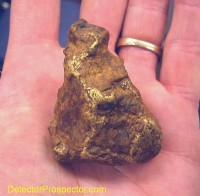
3.47 ounce gold specimen found with Minelab GP 3000 - fresh out of the ground with rinse in nearby pond
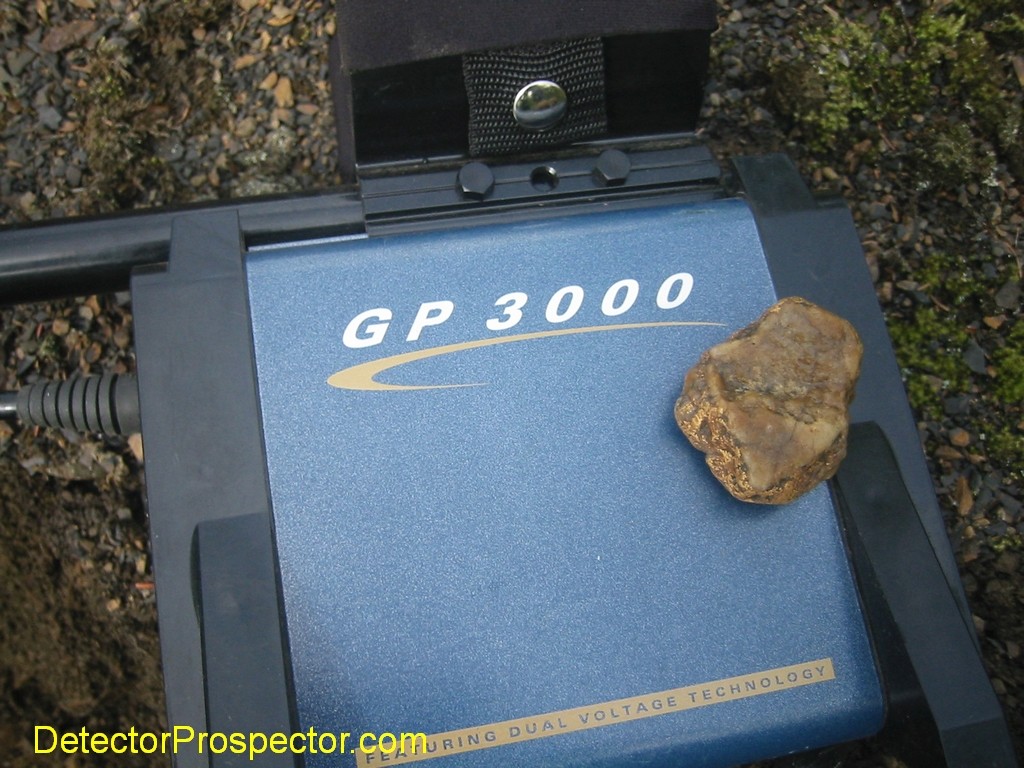
A closer view of 3.47 oz gold specimen from Moore Creek - my first chunk over an ounce at Moore Creek
As you can see from photos below the nuggets are very coarse and many contain lots of quartz. Quite a few are sections of quartz vein shot through the centers with cores of nearly solid gold. The largest nugget, the white piece in the upper right hand corner, pretty much looks like a quartz rock seen from either side. But seen on edge it has a 1/2" thick layer of gold running through it. I'll be doing specific gravity tests on many of these nuggets to find out the gold to quartz ratios and will report them here later. The total weight of that particular piece is 3.47 Troy ounces.
My favorite nugget is probably the 3.15 ounce piece pictured below. It has darker quartz that runs from deep reddish brown to almost black. Between the color and the pitting it looks a lot like a gold meteorite. It's thicker and rounder than the other gold and appears to come from a different source. The 3.5 ounce specimen above is more typical of Moore Creek - a thick layer of gold with a skin of white quartz on two sides. These are chunks of extremely rich gold veins that have broken out of the source nearby and are now scattered down the creek.
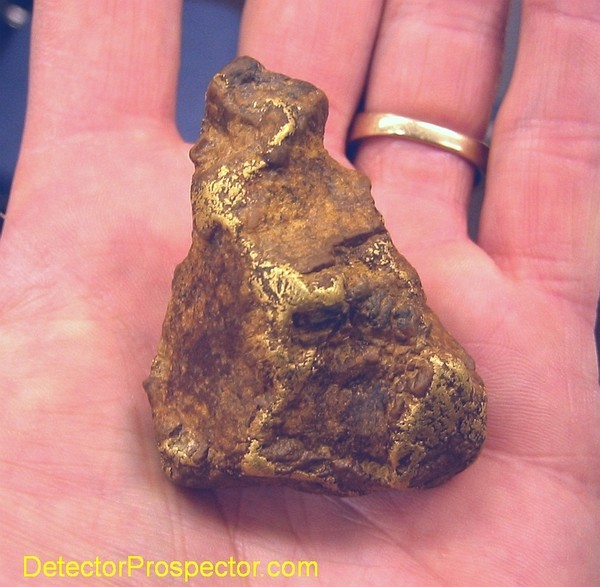
3.15 ounce gold specimen found at Moore Creek with GP 3000
The weather was great, the mosquitoes not bad, and the gold fantastic. It's certainly enhanced our feelings about the claims, as at least some of the tailing piles obviously have some significant gold in them. Some of them may be worth reprocessing.
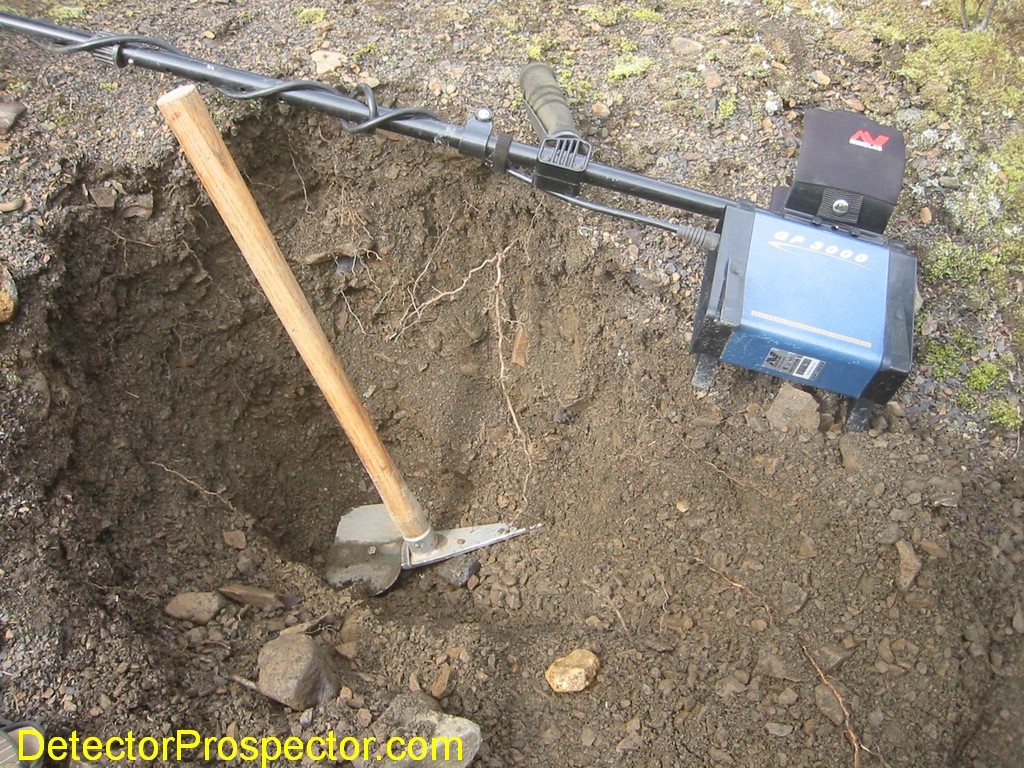
Here is the Coiltek 12"x24" UFO coil along with a 0.55 ounce nugget I just excavated. It really puts a smile on my face digging these things up! The UFO coil is very nice. Very light for it's size due to the open spoke design. In brush you need the coil cover (comes with) to avoid hanging up on sticks. My favorite thing about it is that it pinpoints like a dream. Just drag the tip of the coil pointed straight down over the target and you get a sharp signal off the tip. The narrow design works better in the excavated holes than the round coils.
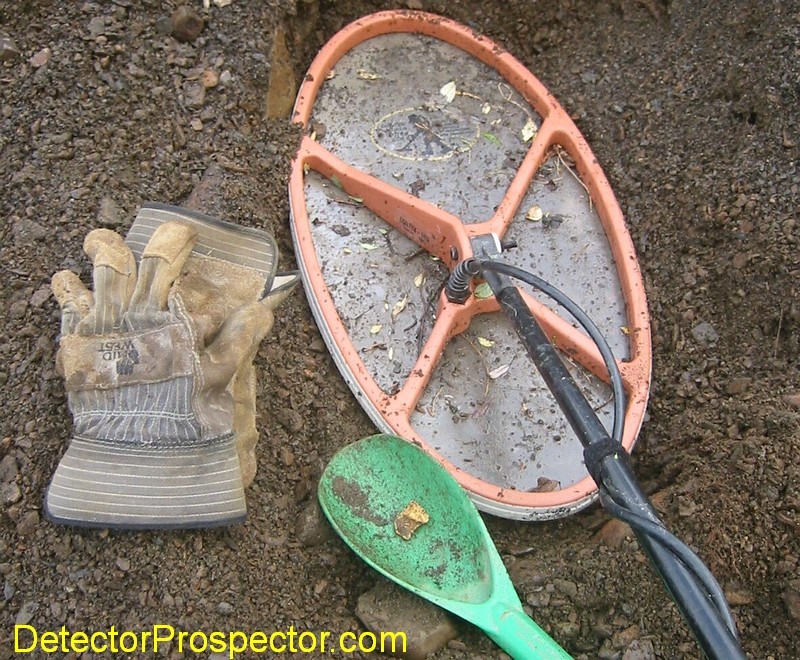
24" x 12" Coiltek "UFO" mono coil for Minelab detectors
I actually found almost all iron gave a low tone with the unit as opposed to a high tone for the gold, but a large enough nugget will also give a low tone, so I just dig it all. Luckily, this is not too much of a burden at Moore Creek. I only abandoned one target giving me a low tone since the last few were all iron, but I'll go back and get it someday when I'm not as tired. The combo ignored 99% of the hot rocks, but some were so hot compared to the ground I got a faint signal with the mono coil. Luckily these were always shallow isolated rocks that needed no more than a kick to eliminate them.
I can't overemphasize enough how this really is a dream of a lifetime for me... and I know it is for many. I've been involved in various mining claims since the 1970's, but it was on local creeks like Stetson Creek, Cooper Creek, Canyon Creek, and then Mills Creek. They were all "working man's claims" suitable for dredging but just not the kinds of places that are destined to knock your socks off with gold. Good stuff, but you really have to work for it. And the chances of finding "the big one" are nil. In all my years on the Kenai Peninsula I have found only one nugget that is just shy of an ounce.
No, what I've always wanted was someplace that I might find larger gold, and someplace I might really be able to mine. I've come close a couple times, and in fact nearly ended up with Moore Creek back in 1998. It would have involved taking advantage of a paperwork snafu by the legitimate owners, and so I backed off. It has paid off as it was my actions at that time that has finally put the property in my hands now. On good terms with all involved. After over 30 years of searching and dreaming it looks like I've found that magic place. I have to tell you that last week, as I sat on top of a tailing pile in the sun with a pocket full of nuggets... well, the feeling was truly indescribable.
Anyway, hopefully some of you that do not have the opportunity that I have had can at least live a bit of the dream as I keep the story going. Or maybe it will motivate a few to keep pursuing the dream!
Are there mining claims for sale? Well, there always are claims for sale. Most people, including myself, would probably prefer to stake our own claims. The problem is finding good ground open to staking. It's easy to find "OK" ground to stake, but to find real serious mining ground, like a Moore Creek, just sitting open waiting to be claimed is very difficult. Difficult as in time consuming. You basically have to make a job of claims research and constantly looking for a prime piece of ground to lapse for some weird reason, like the owner dying with no heir. But most really good ground stays under claim and in many cases stays within families for generations.
Long story short is that buying good ground will get you there quicker. The problem there is of course money. Good ground does not come cheap. In mining claims you often do not get what you pay for. Many poor and worthless claims are sold for way too much money on a regular basis. On the other hand you will have to pay well to get good ground. In that sense you do get what you pay for.
Frankly, that has been part of my problem. If I had been offered Moore Creek even just a few years ago I would not have had the money, although I still could have found others to invest to make it happen. Despite being a business owner I really am just a working stiff making a living, and running two daughters through college had me totally broke until very recently. I've just been getting my head above water, so the offer to sell came at the right time for me. Even so I needed others as this kind of stuff just costs way more than I have to spend by myself. I'm not willing to disclose what we paid for the property, but all I will say is that you'd better be prepared to spend hundreds of thousands of dollars for decent claims with equipment. And if you are looking at patented ground, do not be surprised to be looking at millions of dollars.

Detecting tailing piles - note parallel paths walked on piles from top to bottom - "corkscrewing"
You can find mining claims listed for sale online at Mining Claims For Sale to get an idea of price ranges. In general, claims in the Anchorage area that are suitable for small scale dredging and such, the kind of ground where you might get an ounce of gold in a day once in a while with a 4" or 5" dredge, run from about $5000 to $15,000 per 20 acre claim. I've bought into a couple of these type claims in the past and was happy with the results.
As soon as you start talking larger properties with real potential for heavy equipment mining the sky is the limit. It varies wildly due to things like how rich the ground is, access issues, potential restrictions on mining, amount of equipment included, etc. Patented ground, which is in fact private property, carries the biggest premium, as you can use it for more than just mining.
One big thing to really watch these days is the "mining restrictions" issue. The Mills Creek claims where good ole Bob(AK) is getting all the beautiful gold have real potential for heavy equipment mining. I think a little hoe and trommel operation in there could make a good go of it. The problem is a rabid anti-mining attitude in the Chugach National Forest. In theory those folks are supposed to support mining under the multi-use concept of our National Forests. That is the way it was as recently as 20 years ago. But it seems they have decided National Forest means National Park, and I've heard lots of stories of small miners being bullied and lied to in the last few years. A guy that knows the law and is willing to stand his ground could mine in the Forest, but they would be waiting to pounce on the smallest error.
The feeling today is that State mining claims are the way to go, because Alaska still looks to mining for revenue and jobs. The attitude varies somewhat depending on who is governor, but in general at its worst it is still better than the Feds. The only place Federal claims may be ok are those way out in the middle of unrestricted BLM administered land.
I do have to note on partnerships - they can work. In fact, I've always had partners on all the claims I've been involved with. It helps to know the people, but do not rely on that. A good set of written rules, agreed on in advance by all, can go a long way towards avoiding problems. Do not avoid discussing hard issues, like what to do about a disagreeable partner. If these things are not clearly spelled out in advance you can expect trouble. Even then you may have trouble, but with a formal set of rules that is agreed upon, signed, notarized, etc. you have a legally binding contract to handle disputes.
The good news is that the process of developing such a set of rules will bring all involved to a common understanding and avoid the problems. Most issues simply develop due to a lack of understanding between partners about certain issues.
Here is a simple example. I have three partners. I have by far the most experience nugget detecting. It can be expected I will find more gold detecting. I actually worried about being too successful, and so a guideline I came up with is:
1. 50% of all gold found with a detector goes into the "group claims fund". Division is by weight as decided by the finder.
2. 25% of all gold found by motorized equipment such as dredges or highbankers goes into the group fund.
3. All gold found hand mining, such as in panning or sluicing, may be kept by the finder.
The rules apply to everyone, including visitors like my cousin. Although in his case (he found a 1/2 ounce nugget) I'm covering his percentage out of my finds.
Now why would I come up with a deal like this when I know I'm likely to find the most gold detecting? Fairness. Be fair with your partners. We all have invested equal sums, but we all have varying abilities and time. If partner A looks on while partner B is finding a bunch of gold on "his" claims and partner A is getting nothing... well, let's just say that smells like potential trouble to me.
So I find about two pounds of gold. One pound of my choosing will go in the claims fund. As a group we decide what to do with the fund. We could split it later four ways, in which case I get 25% back. More likely we will sell out of it to raise funds for claim and permit fees and other expenses.
This system in a way costs me potential gold finds I may make. But I simply feel better knowing everyone is seeing benefits from their investment. It makes people happy to see the other guy succeed, rather than laying the groundwork for possible resentment. And let's face it, the tables could turn, I could be busy on other projects, and still seeing some gold come my way from a partner who scores at the claims.
In the other claim partnerships I've been in it's been keep all you find, and that can work well also. Or all gold can go in the pot, expenses covered, profits split. You just have to look at the particular situation and really do your best to be fair to all involved. Look out for partners that are totally in it for themselves... they will be trouble. Everyone in a partnership needs to be looking out for the group. You want team players, and as miners are rugged individualists this is the root of most problems.
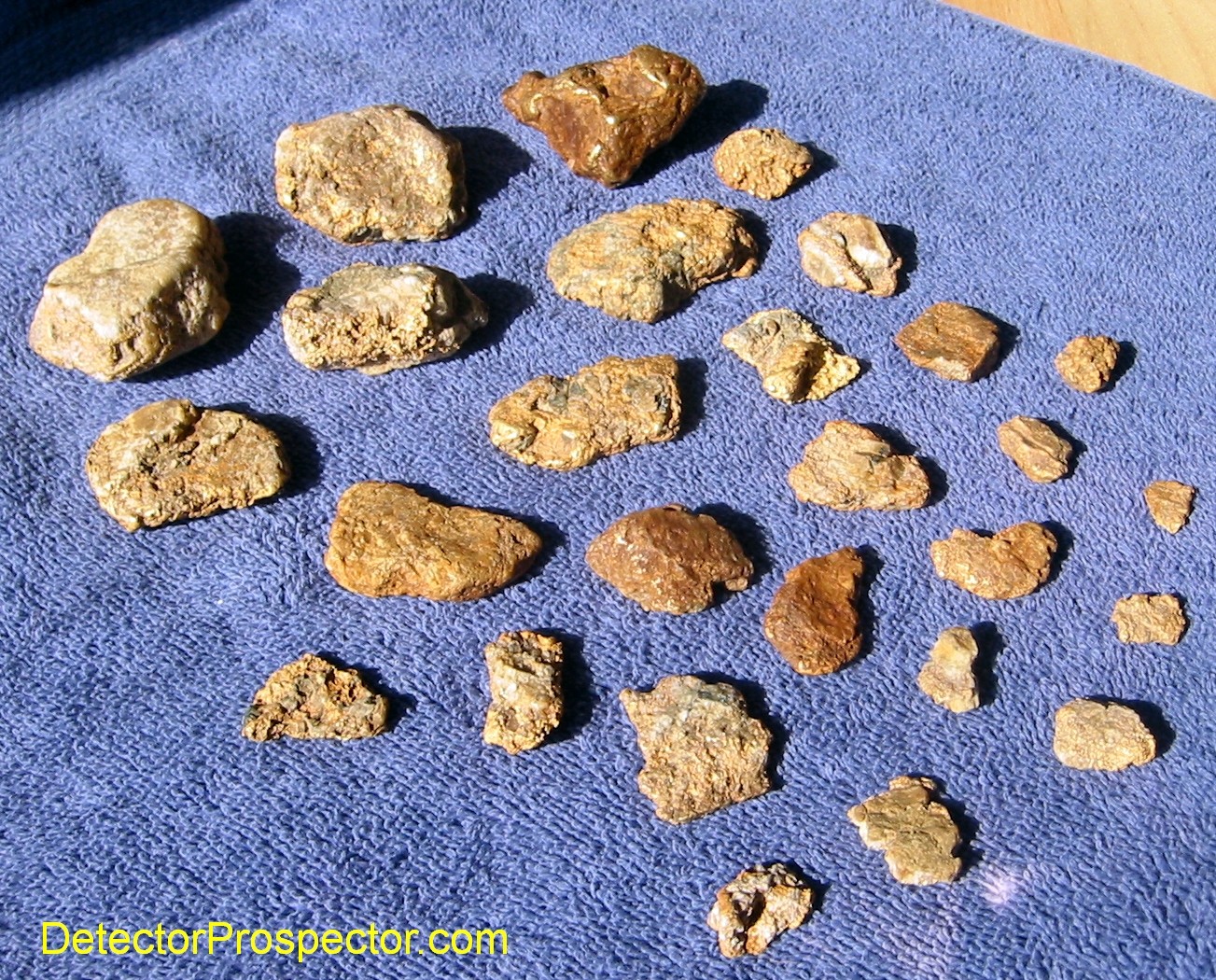
Just over 23 ounces gold specimens found by Steve with GP 3000 at Moore Creek, Alaska
One other stipulation is that since we are truly and seriously doing exploration and evaluation, all finds must be noted as to location, nature of deposit, amount found, etc. I'm collecting and mapping this info, and already know of several particular tailing piles that I believe have literally hundreds of ounces of gold in them. Information collected like this is of immense value and should not be overlooked. If you get a group of partners that get competitive and secretive about their finds this kind of information will be difficult to develop.
Testing is what it is all about. I'm amazed at how many people just get ground and start mining. And then are surprised when they go broke. Real mining should never commence until proper testing has proven it will pay. Too many miners figure the expense of testing is throwing money away they could just use for mining. But to commence mining without proper testing is not mining... it's gambling.
Here is another guideline regarding buying mining claims. Never invest a single dollar that you cannot afford to just walk away from. Especially in partnerships. Failure is a lot less painful if you are not hocked to the hilt. Partnerships are easier to handle if you always know you can just walk away from a bad situation.
But enough of that talk. We are off and running on our new claims at Moore Creek. Everything looks great so far, what with a pile of chunky gold specimens recovered already. There is a lot of work to do yet, and a lot more test work remains before we really know just how much potential the ground holds. I cannot help be be optimistic at this point that we are really onto something at Moore Creek.
~ Steve Herschbach
Copyright © 2003 Herschbach Enterprises
-
 2
2