
Every once in awhile our company is awarded a trip by one vendor or another for setting a sales record or some other goal. So it was that Honda Power Equipment sent my partner Dudley and I on a short trip to Cabo San Lucas for a dealer meeting. Yeah, I know... rough duty! And yes, we did not work as much as enjoy ourselves while there. But I was plenty busy and so did not spend as much time detecting as I would on a vacation trip. Still, the trip offered me a chance to give the new Minelab X-Terra 50 a spin. Since part of my job is selling detectors I actually have to bear the heavy responsibility of using new detectors when they come out so I can speak knowledgeably about them.
The X-Terra 50 really is perfect for this kind of trip. One where detecting is mostly a "maybe" thing and so I just want a machine I can bring along that will not take much room. Not to pick on other brands, and in fact I am a White's fan if anything, but my MXT and DFX seem designed to not fit nicely in a suitcase. They stick out every which way and take up a lot of space. So part of the reason I liked the X-Terra the instant I got my hands on one was it looked like the perfect travel unit. It easily packs in a normal size carry-on bag. I do not like to check baggage when on trips like this and so space is at a premium for me. The X-Terra 50 made it easy for me to get everything I needed for this trip into two carry-on bags. Nice!
We stayed at the Sheraton in Cabo. Normally I would hit the water with my Surf PI Pro on a trip like this, but this location has a huge surf and undertow such that people do not swim in the water, at least none but a few very brave souls. If I got in the water I'd be more concerned with not drowning than detecting and so that normally lucrative type of detecting was not to be had here. I do 100 times better in the water than on the dry beach, but that is what I had here and so you go ahead and make do with what you have. Since dry beach was the deal the X-Terra replaced my Surf PI for this trip.
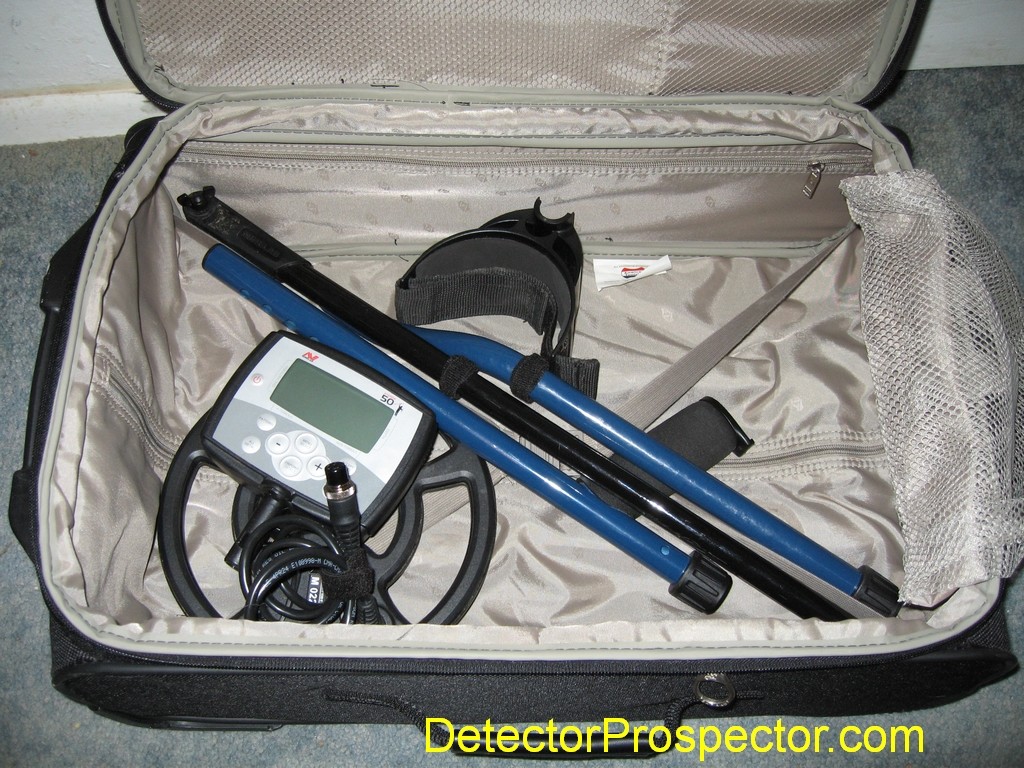
Minelab X-Terra 50 packs easily into a standard airline carry on bag
The beach is made up of decomposed granite and has a few layers of black sand in it. It balanced out at "3" pretty well. In all-metal and at full sensitivity the machine constantly puttered out low tone sounds and readings of -9 on the readout. Being a single frequency unit with no salt setting this constant low background readings of -9 are attributable to a combination of the mineralized ground and the salt. Lowering sensitivity to eliminate the signals had too much effect for me. The sounds did not go away until the max setting of 20 was reduced to about 10. Running at full 20 and then setting -9 to reject made the machine totally silent with no loss of sensitivity and so setting -9 to reject looks to be in effect the "salt setting" on the X-Terra 50 for this location.
The X-Terra 50 like many detectors aimed at the general market is locked into discrimination modes. This means that even if you set the detector to pick up everything, the signal is still being filtered. The process is "detect, identify, report". If you set it to report all items, the identify process is still going on. Top notch detectors used mainly for gold nugget detecting always offer an unfiltered "All Metal" mode that is distinctly different then the so-called all metal mode on units like the X-Terra 50. In a true all metal mode the process is "detect, report". The filtering is completely removed and this results in more sensitivity to small items and better depth of detection. The penalty is you truly dig it all but for high value targets it is often worth it.
It is important to note that the X-Terra 50 has three levels of ferrous rejection, -3, -6, and -9. The X-Terra 30 has only one, -4. This means I can set the X-Terra 50 to reject salt readings at this particular beach and still get small non-ferrous targets that tend to read as -3 or -6. The X-Terra 30 lumps them all together into -4 and so on this basis alone I think the X-Terra 50 handles salt beaches better when looking for tiny items. More on this later. Being able to ground balance was also critical to being able to run at high sensitivity. Going just up or down one notch on the ground balance generated far more noise, as I found when I tried to run either slightly negative or slightly positive on the ground balance.
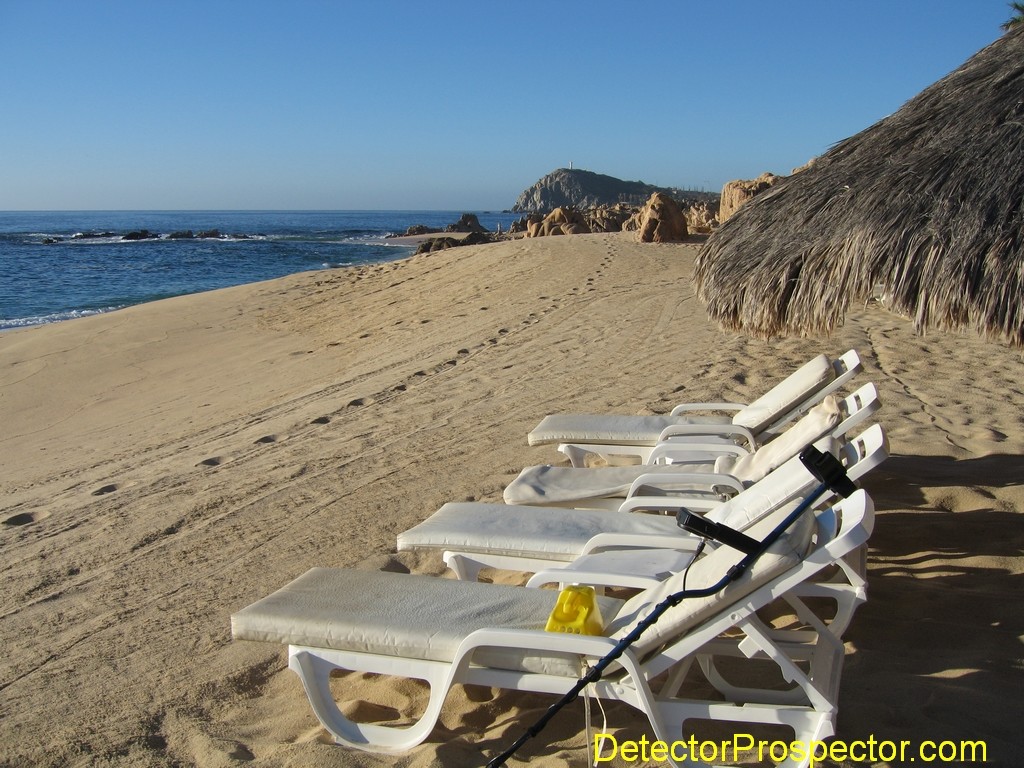
The beach at Cabo San Lucas, Mexico
One thing you must keep in mind here... I run my machines on the ragged edge of sensitivity and so they run noisy and erratic. I am ok with this and it is not a reflection on the detector. In fact I do not like machines that do not allow for what would be termed "too much" sensitivity or gain. Sometimes the manufacturers are looking out for us and so do not allow a machine to be cranked up too high, as it often is not a good idea. Works for me though, and the X-Terra was able to run at full-out setting of 20 here and run quite well. The machine was actually very quiet, almost weirdly so if I set -9 to reject. But the high sensitivity level was reflected in erratic target id with lots of "bounce".
I ran most of the time either wide open with even -9 set to accept and so listening to a constant low level puttering that at low volume levels was not all that unpleasant, or with -9 set to reject. I pretty much just wanted to dig everything to see what readings I got and how small the targets might be that I could hit. I know from experience that almost any detector will call tiny non-ferrous items ferrous... one of the lies discriminating systems foist on us and that cost us lots of little gold targets when we set for ferrous rejection. About the only machine I halfway trust on this issue is my Gold Bug 2, and I even managed to find a small gold nugget once that the Gold Bug 2 insisted was iron, so even it can be fooled.
The more iron mineralization in the ground, the more likely machines are to lie about small non-ferrous items, and unfortunately the X-Terra 50 is no different. Maybe the 18.75 kHz coil will help but tiny non-ferrous items commonly read -3 or -6, although they will usually "bounce" to a higher reading and tone also. They also will bounce to -9. So when I ran the X-Terra 50 with -6 and -3 rejected, small non-ferrous items (usually foil) might be detected or might not on a single sweep. If you are lucky, you get a low mid tone, but if you are unlucky the item may go negative and so get missed. But accepting non-ferrous all items beep, and then a few sweeps over the items will either reveal it to remain consistently negative and low tone and so is iron, or it will bounce and chirp higher tone and number now and then. Those that do tend to be tiny non-ferrous items.
This beach was not a big treasure chest. The people were pretty low key, just sitting in the sun, so not lots of activity to generate jewelry losses. And on top of that I'm certain I'm not the first guy to detect this beach. Finds were pretty sparse, but find stuff I did. And digging it all, it was naturally mostly junk.
Bottle caps all read ferrous but often spiked to a high 45 beep. I do not think I'd dig many bottle caps with the X-Terra if I did not want to. They all were very distinctive readings. Other than the bottle caps, most items read where I would expect, but all my readings were very bouncy. Solid locks were very rare. So coins would bounce around at higher numbers, tabs would bounce around in the middle tones, and foils would bounce around in mid and lo tones and plus and negative numbers. In other words, do not look for solid id locks on a mineralized beach soaked in salt water with the sensitivity cranked up. Surprised? I was not.
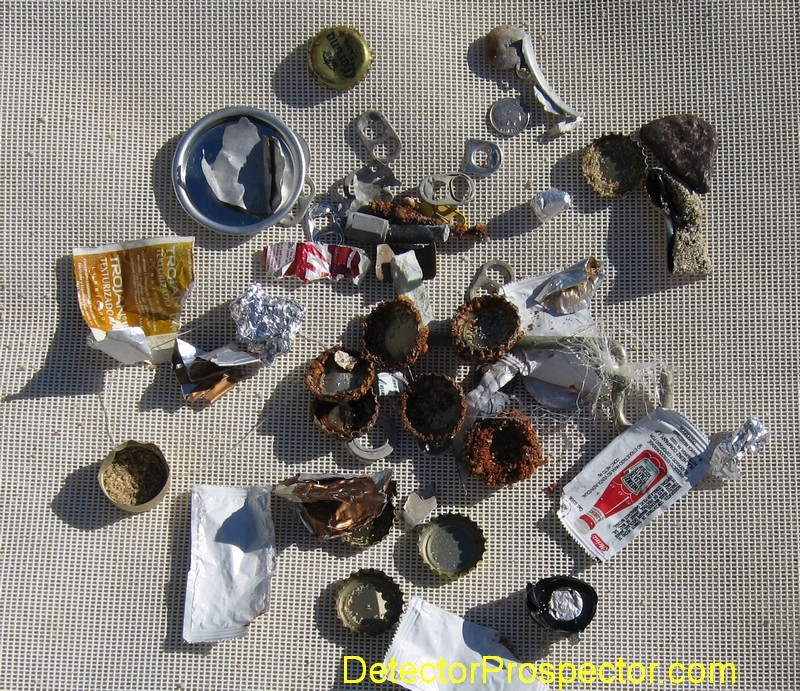
Junk items recovered while detecting
The bottom line here is simple. The X-Terra 50 actually worked very well for me on this beach. No, I did not bury targets and measure depths. I was just detecting. But I did not feel I was using a machine giving me shallow performance. I dug coins at easy 6-8 inch depths, and pop can halves at over a foot. Performance for a single frequency machine seemed just fine to me.
What seemed exceptional, truly, was the small item sensitivity. I hit lots of tiny foil strips and a few small pieces of broken silver jewelry that really impressed me. One target, a thin jump ring with a gap in it should not have been detectable with a 7.5 kHz machine with a 9" coil. I'm still surprised I hit that thing! The depths on these tiny targets were around an inch or less, and up to a couple inches for slightly larger but still very small pieces of foil, but the sensitivity of the X-Terra 50 to small items is impressive.
If I could have one wish, it would be that the all-metal mode on the X-Terra 50 was a threshold based single tone. You can take any of the two disc modes and by setting all segments to accept get exactly the same thing as the all-metal mode. Beeps on everything, in four tones. I feel the all-metal mode should have been a threshold based single tone setting to make for a better small item mode. I tried running in pinpoint, but it detunes too rapidly to be used as a search mode. Having an all-metal mode that offers some kind of functionality beyond a disc mode with all segments set to accept would have helped for this type of detecting. The machine obviously does work, and does hit the tiny targets anyway, but they are bouncy between lo and mid-lo tone and so a single tone at least would work a bit better for me. In practice it was fine, however. Just get a tiny bloopy-beep, and make sure you have a plastic nugget scoop to isolate and recover it! I quit using my sifter and switched to the scoop right away as these tiny targets just fell though the holes in my sifter. It was more like nugget detecting than coin detecting.
I can only speculate what smaller coils might do, and what higher frequency coils might do. Put a small 18.75 kHz coil on this unit and it may rival some of the best gold nugget detectors on the market for small gold sensitivity. I have no doubt from what I saw under these adverse conditions that I can go find gold nuggets with an X-Terra 50, as is out of the box with 7.5 kHz 9" coil. This detector is hot on small items.
In summary, I found the X-Terra 50 to be a fine beach unit. It sure will not outperform my White's Surf PI Pro for depth so do not bother telling me how your multi frequency machine will probably get better performance on a salt beach than the X-Terra. Because my PI unit will probably beat your dual or multi frequency unit also when it comes to depth. I'm not telling everyone to go and run out and get an X-Terra for beach detecting. What I am saying here is that if you own one you sure will not be disappointed in it if you get it on a saltwater beach now and then. As single frequency machines go I thought it did great. And at a better location with more activity I have no doubt I can hit smaller gold targets with the X-Terra 50 than people are going to get with most beach units, or at least up in the drier sand.
It has been said before and some have tried to take it as a negative but it is not - the X-Terra is a fun metal detector to use. But I'm the kind of guy that thinks digging small foil is fun so one must question my opinions on what is fun!
Oh yeah, I almost forgot. I have seen some posts about the X-Terra lower rod being too long. It never seemed that way to me, but this time I paid particular attention. I am 5'11" and I stand up fairly straight. I ran the X-Terra the third notch up this whole trip, which leaves two longer settings and three shorter settings. If anything the length is perfect for me with adjustment either way. So while I can understand how the more vertically challenged may feel, it looks like Minelab had me in mind when they designed the lower rod. One of those areas where you cannot please everyone, apparently.
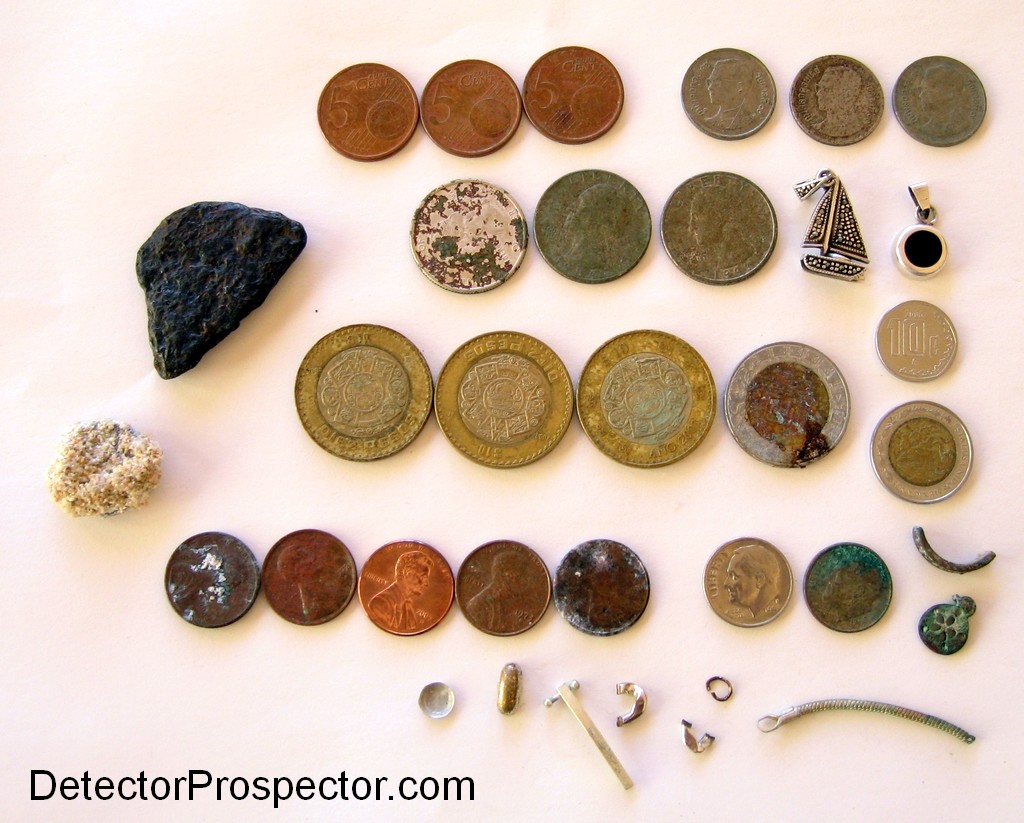
Coins and jewelry bits found with Minelab X-Terra 50 on beach at Cabo
I've been running lots of trash, common coins, and rings under my XT50. Here is a general chart. Important - these are air tests. In the ground readings will often shift lower.
Tone - VDI - Items
Very Hi 45 Steel Halves, Dollars
Very Hi 42 Quarters, Large Silver Rings
High .... 39 Silver Rings
High .... 36 Penny/Dime, Small Silver Rings
High .... 33 Indian Head Penny
High .... 30 Zinc Penny, Indian Head Penny
High .... 27 Screw Cap, Indian Head Penny, Large Aluminum
Medium 24 Heavy Square Tabs, $5 Gold, Very Large Men's Rings
Medium 21 Large Pull Tabs, Large Men's Rings
Medium 18 Pull Tabs Men's Rings
Medium 15 Small Pull Tabs, Erasers, Small Men's Rings
Medium 12 Light Square Tabs, Nickels, Erasers, Beavertails, Large Women's Rings
Medium 09 Beavertails, Heavy Foil, Erasers, Medium Women's Rings
Medium 06 Medium Foil, Small Women's Rings
Medium 03 Light Foil, Small Jewelry
Low ..... -3 Wire, Pins, Very Small Jewelry (Post Earrings, Thin Chains)
Low ..... -6 Nails
Low ..... -9 Hot Rock, Large Iron
Notes - 45 is more often a junk indication than the very rare dollar or half. Men's rings fall mostly into 21 followed by 24. Women's rings are heavy in 6 and 9 followed by 12. 18 is the heavy pull tab range and sparse on rings (too high for most women's rings, too low for most men's). 15 also has fewer rings but also less junk. All these observations are only true for my area and mix of targets and so must be taken with a large grain of salt, are are only intended as an aid to those just starting out. You can get junk in any segment, and good finds in any segment!
Here is a simplified version, a combination of most likely targets and "wishful thinking". 21 is more likely to be a large pull tab, but it is the hottest number for men's rings, at least out of my collection. 18 might be a ring, but fewer fall there than in lower or higher numbers, and it is very heavy in common pull tabs.
45 Steel
42 Quarter
39 Silver
36 Penny/Dime
33 IH Penny
30 Zinc Penny
27 Screw Cap
24 Large Men's Ring
21 Men's Ring
18 Large Tab
15 Small Tab
12 Nickel
09 Women's Ring
06 Small Women's Ring
03 Foil
-3 Wire
-6 Nails
-9 Hot Rock
Update 2011: Not very long after the X-Terra 50 came out with the X-Terra 70. This irritated a lot of people who thought the X-Terra 50 was going to be the top-end unit. The X-Terra 70 offered the true all metal mode that the X-Terra 50 lacked, making it a superior detector for gold nugget detecting in particular. The X-Terra 70 was later replaced by the Minelab X-Terra 705, a detector I currently own. It is a very good light weight detector for all around use.
~ Steve Herschbach
Copyright © 2006 Herschbach Enterprises
-
 1
1
-
 1
1