
Well, here is a report on my last visit to Ganes Creek, Alaska for the year. I set myself up for this visit this spring by saying I would go to the mine after everyone had been there this year and find gold, just to prove there was still some left to detect. To show that it just can't all be found... no matter how thorough the hunters. I also wanted an opportunity to work with some new machines, and so in addition to my White's GMT I brought along a new White's MXT and Garrett Infinium LS.
Brian, Jeff, and I left Thursday morning for a five day visit. We got to Ganes and settled in, then decided what to do. Brian was set on doing some prospecting with the 5" dredge Doug had purchased for visitors to use, so he was off in search of places to use it. I grabbed my new Garrett Infinium LS detector to try out, and Jeff used my White's GMT. Jeff and I headed upstream to where most of the large nuggets have been found this summer, on the theory that more were waiting to be found in the area.
We scanned an area that has been heavily hunted. Three nuggets over 5 ounces were detected in the area this year, and I found out it is the same area where the 122 ounce nugget and a 62 ounce nugget were found. Definitely the center of big gold on the creek.
The Infinium ran smooth and clear, so much so that I found myself waving my ring over the coil to make sure it was really working. Absolutely no signals from rocks in the tailing piles. Very odd when you are used to constant background sounds back from a VLF detector. The Infinium is a ground balancing pulse induction (PI) detector and as such it excels at canceling out ground mineralization. I got a signal now and then, and dug either a shell casing, or an iron trash target.
The discrimination on PI detectors is crude at best, and so iron targets that might be rejected with a VLF (Very Low Frequency) will often be signaled as "good" on a PI detector like the Infinium LS. The basic idea with PI detectors is to go ahead and dig everything, although this can be problematic at a place with so much junk as Ganes Creek. I found the shell casings encouraging however, as that meant that not everything had been detected. I figure if non-ferrous items like bullets and shell casings are being missed, then some gold has also been left behind.
Still, the area had been well searched, and the finds were few. I finally located a 13.8 dwt (dwt = pennyweight) nugget, and then a 3.8 dwt nugget (20 pennyweight per ounce). Two very nice, relatively solid gold nuggets. The Infinium had done its job. Jeff, although he tried his darndest, came up with no nuggets. The area has been hammered pretty good. We also tried some old tailings upstream farther, but found no more gold that day.
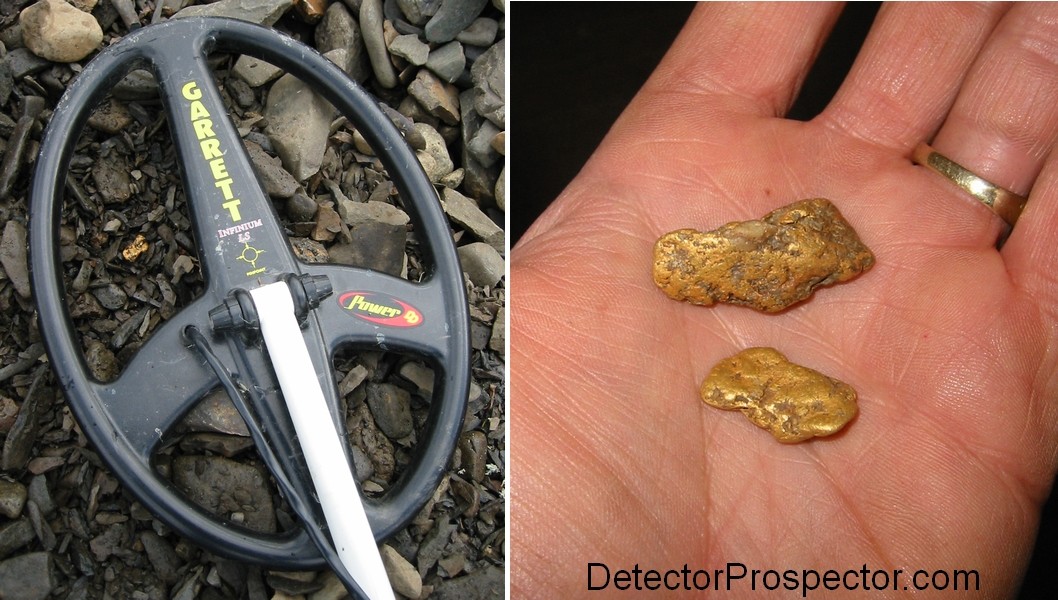
Gold nuggets found with Garrett Infinium at Ganes Creek
Day Two dawned under rainy skies. We decided to stay near camp, and see if there were more nuggets waiting to found around the cabins. I grabbed the new White's MXT, while Jeff stuck with the GMT. The rain got going pretty good, but we stuck with it. Lots of bullets and shell casings were dug, again, a good sign. But by the end of the day we had no nuggets. We headed up to the bench deposits above camp and found some small nuggets, just so we could say we did not get skunked. Jeff found a nice little nugget over a pennyweight with the GMT, and I got a few tiny bits.
The MXT is a brand new detector from White's Electronics. Steve Houston from White's had a prototype MXT along on his visit to Ganes Creek in the spring and I had a chance to use it then. We both agreed then it had all the right stuff for finding gold at Ganes Creek. We did not use it much, however, as time was limited and we stuck with more familiar detectors.
I have to note that I was very impressed with the MXT around camp. I used the 6" elliptical coil, and ran the unit in the relic mode. This mode, when set up a certain way, gives a high tone on non-ferrous targets, and low tone on iron targets. A setting right at "2" seemed to be the point where ferrous and non-ferrous sorted out with low and high tones. It was easy and efficient around camp, and all I dug were non-ferrous items. It has very good trash separation with the small coil, and easy id with the dual tone system. Great for places where trash is literally inches apart.
Brian had set up in the ditch near the big nugget area, but was plagued with start-up problems with the gear, especially a leaky pump intake hose. He spent most of his day just getting set up and getting the dredge operating.

Brian running suction dredge at Ganes Creek
The weather cleared up the third day. Jeff again ran the White's GMT, and I the MXT with small coil as I had been impressed with it the day before. We started in camp, and I found a small nugget just behind the cabins. Then we tried some of the dragline piles above camp near where I found my 4.95 ounce nugget last year. I switched the MXT to the 950 9.5" coil. Both Jeff and I came up with nuggets weighing several pennyweights each.
So far we were not exactly knocking down the nuggets. Frankly, we were both both a bit puzzled, as our constant digging of bullets indicated nuggets were still to be found. You simply can't dig all the gold while leaving the bullets in the ground. But results were lean, and our enthusiasm was flagging.
I'm a big fan of aerial photos, and had some new ones showing an area downstream opposite the old bucket line dredge machine shop. Long rows of old bucketline tailings ran far back away from the road, and so I suggested we go down and check them for a change of pace. Jeff was running the White's GMT with the Sierra Max 14" coil, and I ran the MXT with stock 950 coil.
The more I used the MXT the more I liked it. On the cobble piles I ran in prospect mode, with full gain, minimum V/SAT setting, and in automatic ground balance. The 14 kHz frequency ran smoother on the mixed rocks of the the cobble piles than a higher frequency detector like the White's GMT or Fisher Gold Bug 2. They tend to get weak signals of rocks because of their higher operating frequencies. The MXT was definitely smoother in the cobble piles than the GMT.
We followed an old trail we had followed last year. I concentrated on the edges, off the main trail in the edges of the cobble piles near and in the brush. I got a good, clean signal, and gave a couple digs with my pick. The moss and rocks flipped back, and there lay a large gold nugget!
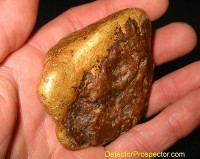
I did not get as excited over this one as my 4.95 ounce nugget last year, as I was not sure exactly how large it was. Jeff, however, knew immediately it was something to jump up and down over. And he was right, as upon weighing it came in at 6.85 ounces. My largest nugget ever, and the largest found at Ganes Creek by visitors with metal detectors this summer. Sorry guys, but you left a big one for me to find!
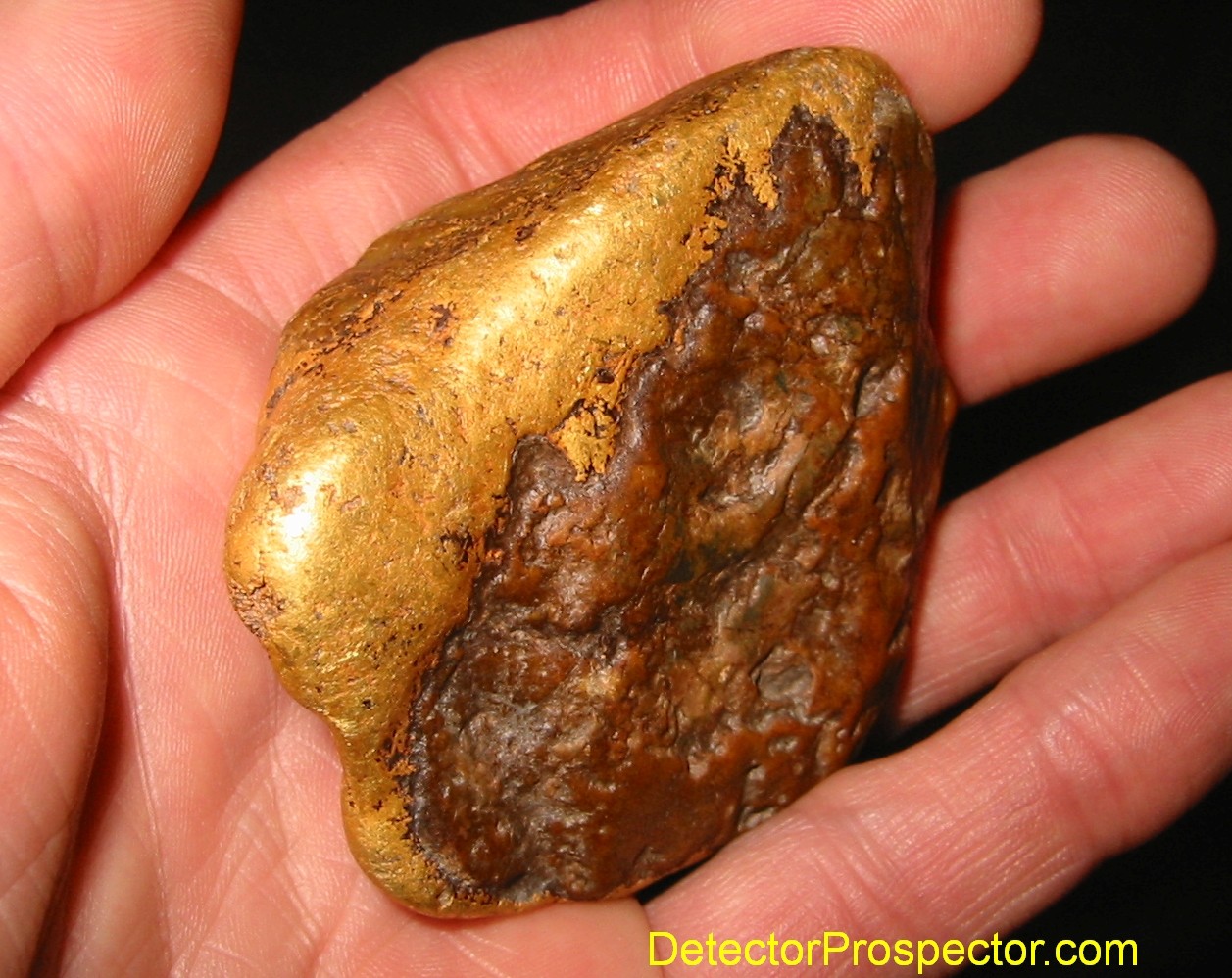
6.85 ounce "Ugly Nugget" gold specimen from Ganes Creek - found by Steve H with White's MXT
The nugget is strange, with very dark, lustrous quartz encasing a solid gold core. The quartz is almost like agate. Fingers of dendritic (leaf) gold reach up from the gold core into the quartz shell. It's a very unique nugget, but I'm hard-pressed to say if I like the looks of it. It has more quartz showing than gold. Some people say it really looks good, others say it's ugly. Oh well, all I know is it weighs more than any other found this summer. And that's remarkable considering the number of people over the ground, proving you just can't get them all.
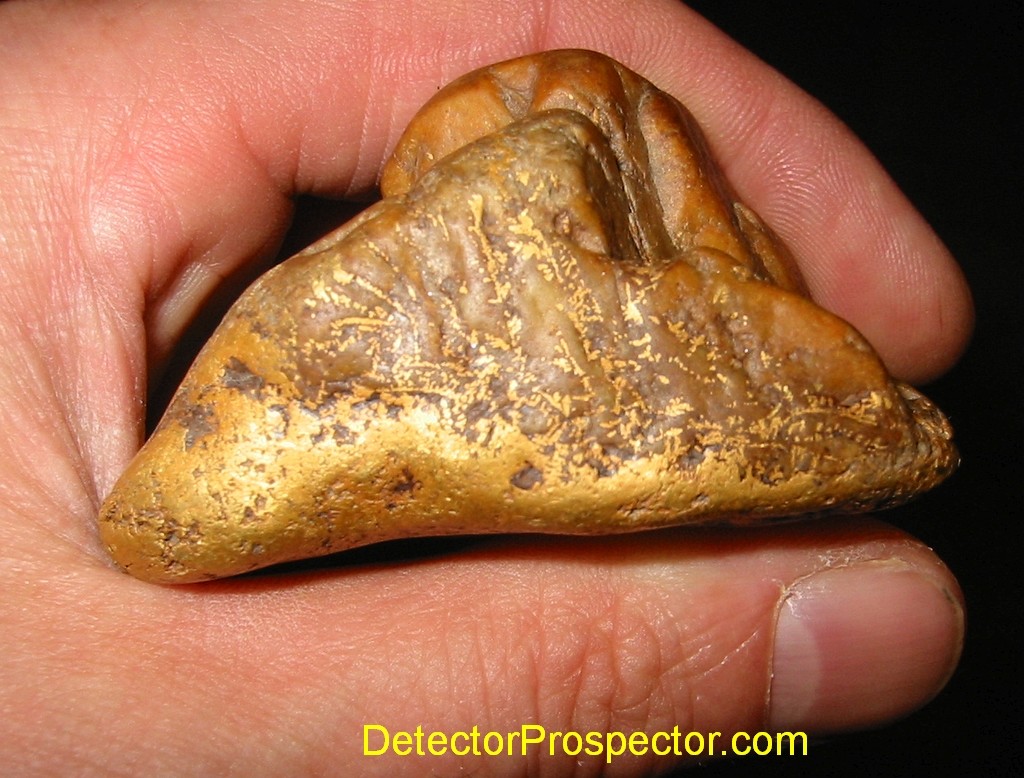
Side view of "Ugly Nugget" showing wispy dendritic gold
Brian's initial dredge hole in the ditch near the big nugget area did not get him excited. A bit of small gold, but no bedrock, and no large nuggets. So he decided to move to a point of bedrock sticking out into the current location of Ganes Creek. The creek has been moved to the north side of the valley, which is reputed to have poor gold, but Brian wanted to check it out. At least there was bedrock showing he could get at.
The next day (Day Four) Jeff took the MXT, and I went back to the Garrett Infinium LS. I wanted to put its ground canceling capabilities to use on the cobble piles, and Jeff wanted to see why I had grown so infatuated with the MXT. What's not to like about a machine that had found me my largest nugget ever? We searched far into the edges of the cobble piles along the creek. Our search led us way out on the dredge cobbles as far from the road as we could get, opposite the old dredge machine shop. There were no signals for some time, as many of these old cobble piles are relatively trash free. I was ahead of Jeff a bit, and so sat down to wait while he scanned up to me. Then he gets a signal in the middle of the cobble piles.
The MXT said only 10% chance it was iron. VDI number of 55, exactly what it called my large nugget. No signal for some time, in big cobble pile... man, this looked good.
He dug and dug. Got to over a foot. All indications were still good. I was getting excited, and came up to take pictures of the big find. And literally cheer him on, as he was getting a bit grumpy about the depth of the hole. The cobbles kept caving in, which can be very frustrating. And I'd exclaim "But Jeff, this is just how digging the two-pounder will be"!
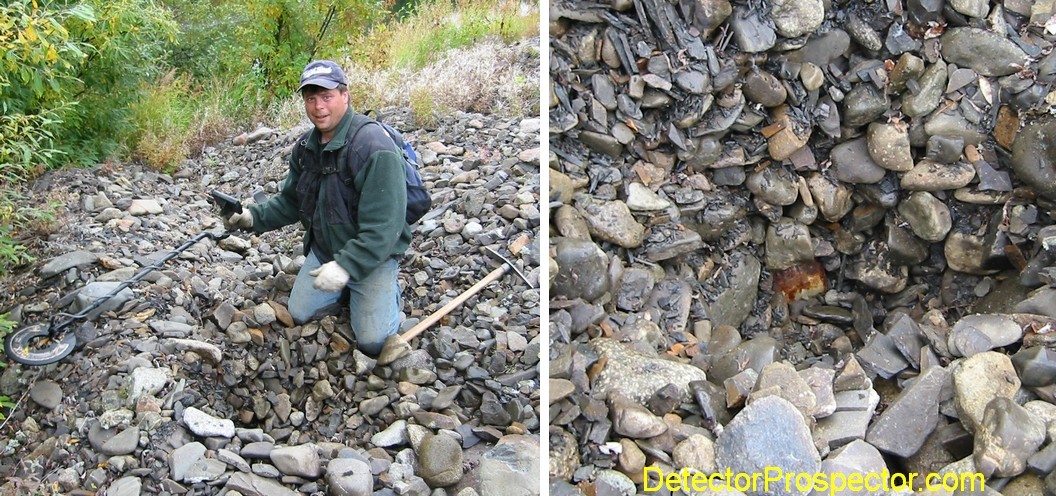
Jeff excavating large "gold nugget" that turned out to be a rusty can
So at two feet, there is the quart paint can. Oh well, such is nugget detecting. Those large steel targets at depth really baffle discrimination systems. What is interesting, however, is I tried the Infinium out on the can, and it did call it an iron target! It seems the PI discrimination system does work well on some items that have problems on the VLF systems. The thing about VLF discrimination is it will sometimes call ferrous items non-ferrous so you dig some junk. With PI discrimination the problem is more serious - a gold nugget can easily be identified as iron, especially the large nuggets, so it is dangerous to use PI discrimination where large nuggets lurk.
In any case, I sure like to see other people find gold. I always get excited when anyone finds gold, because it tells me there is more for me to find also. It's when nobody is finding gold that I get worried, and today was turning into one of those days. One the other hand, if I go out with Jeff one more time and find a big nugget, I'd best not turn my back on him. I'm likely to get hit over the head with a detector!
Since we were having no luck for the day so far we decided to switch gears. Back to the old reliable airstrip to find nuggets. I've found if I'm just patient, dig lots of bullets, I can always find gold on the airstrip or around camp. But since the Infinium has minimal discrimination, and digging the compacted airstrip material is a lot of work, I switched to the GMT. Jeff stuck with the MXT.
Before an hour was up Jeff found a 12.2 dwt nugget. Shortly after I found a 2.7 dwt nugget with the GMT. We both had nuggets for the day. Jeff's was a very nice, nearly solid gold piece. Mine was a broken, very quartzy nugget. Still, that seemed to be it, although we dug a small pile of bullets and shell casings. We headed up to the bench deposits above camp once again to look for smaller gold.
The MXT is a great detector, but the difference in operating frequencies was obvious. We scraped areas free of overburden over the bedrock, and checked them with the detectors. The White's GMT with it's 48 kHz operating frequency had an obvious edge over the 14 kHz White's MXT, even considering the fact that the MXT was using the more sensitive 6" elliptical coil versus the 10" elliptical coil on the GMT. We dug a couple pennyweight of small nuggets, but the GMT clearly got better signals on the small gold.
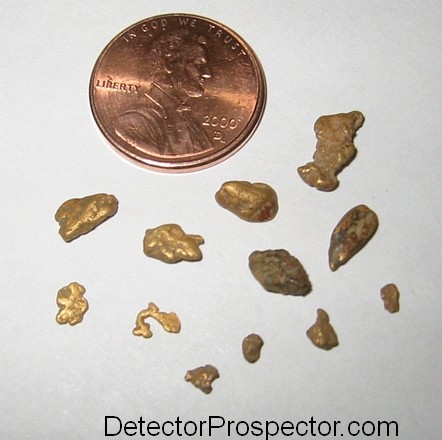
Small gold nuggets found with White's GMT
Brian again found little gold with the dredge, and decided to wrap it up for this trip. He had his work cut out for him pulling the dredge out of the creek and getting all the gear put away.
Day Five dawned a bit cloudy and cool. The only real good thing about this time of then year is the lack of mosquitoes. The cool nights have driven them off, and so our days were relatively mosquito free. A few biting flies replaced them, but not so many that I ever had to use a head net this trip. Cold weather has it's advantages.
Since we were leaving that afternoon, we made a short day of it. I had pulled my left arm out of joint, and so was down to digging only targets that gave perfect id. We did a little detecting in the pile of material near the ditch in front of camp. This pile has produced several nice nuggets, and been heavily detected. But Brian is short order found a nice weighing several pennyweight with the White's GMT. It ended up weighing more than all the gold he got dredging on the trip.
The weather cleared as the day went on, and I decided to spend my last few hours up in the big nugget area near the ditch. I ran the GMT again while Jeff used the MXT. I hit the road itself real hard, as I saw no signs that it had been detected much. But Ganes had given us all the gold it was going to this trip, and we went in early to pack and clean up our cabins. It may be I missed out this last day simply because I passed up lots of targets I normally would have dug.
Well, it was a fun trip, with over 9 ounces of gold found. Even discounting the big nugget I found over an ounce of nuggets, with the largest being 13.8 dwt. Jeff found about an ounce with his largest at 12.2 dwt. Good-sized nuggets remain to be found, and even a few clunkers. Still, the easy pickings are gone, and it will take patient detecting to get results at Ganes Creek now.
There are actually many miles of undetected tailings running upstream above the more recent workings. The areas are generally lightly brushed over, with some large open areas. A few brief exploratory runs into these upper areas have produced no real finds, but the area is vast in extent, and worth attention in the future.
A talk with Doug revealed that next season there will be a lot more work done with bulldozers to make areas "fresh" again. The good news is many worked areas will be rejuvenated in this way. The bad news is you guys that did not dispose of your trash properly... well, it's just going to be there to dig up again. The future at Ganes creek is more likely to be a mixture of working material freshly turned over, and then wandering off searching for those missed areas.
Finally, the detectors themselves. I like the Garrett Infinium LS. It has great bang-for-the-buck in the PI department. Its current lack of accessory coils is the only thing really holding it back at the moment. I see the Infinium as being the machine I will turn to when my normal VLF detectors won't do the trick. Ganes Creek is really not the best area for PI detectors, as the low mineralization and lack of hot rocks means the PI units have no real edge over VLF detectors.
The White's GMT is slowly becoming my primary nugget detector. I've favored the Fisher Gold Bug 2 the last few years, but the extra versatility of the GMT is causing me to use it more and more. The extra depth on large gold versus the Gold Bug 2 is the big plus at Ganes Creek.
The machine that really wowed both Jeff and I was the White's MXT. It's the first detector I've ever used that I really think "does it all". Now, while it bench tests well on small gold, frankly it does not hold a candle to the GMT when it comes to very small gold under actual field conditions. If small gold is your bread and butter, the GMT or Gold Bug 2 are still the way to go. Not only do the higher frequency detectors have an innate edge, but the manual ground balance offers better control for small gold. The MXT must be auto ground balanced, then "locked". The GB point is then fixed, but it cannot be manually adjusted. The GMT has automatic and manual ground balance, while the Gold Bug 2 is manual only.
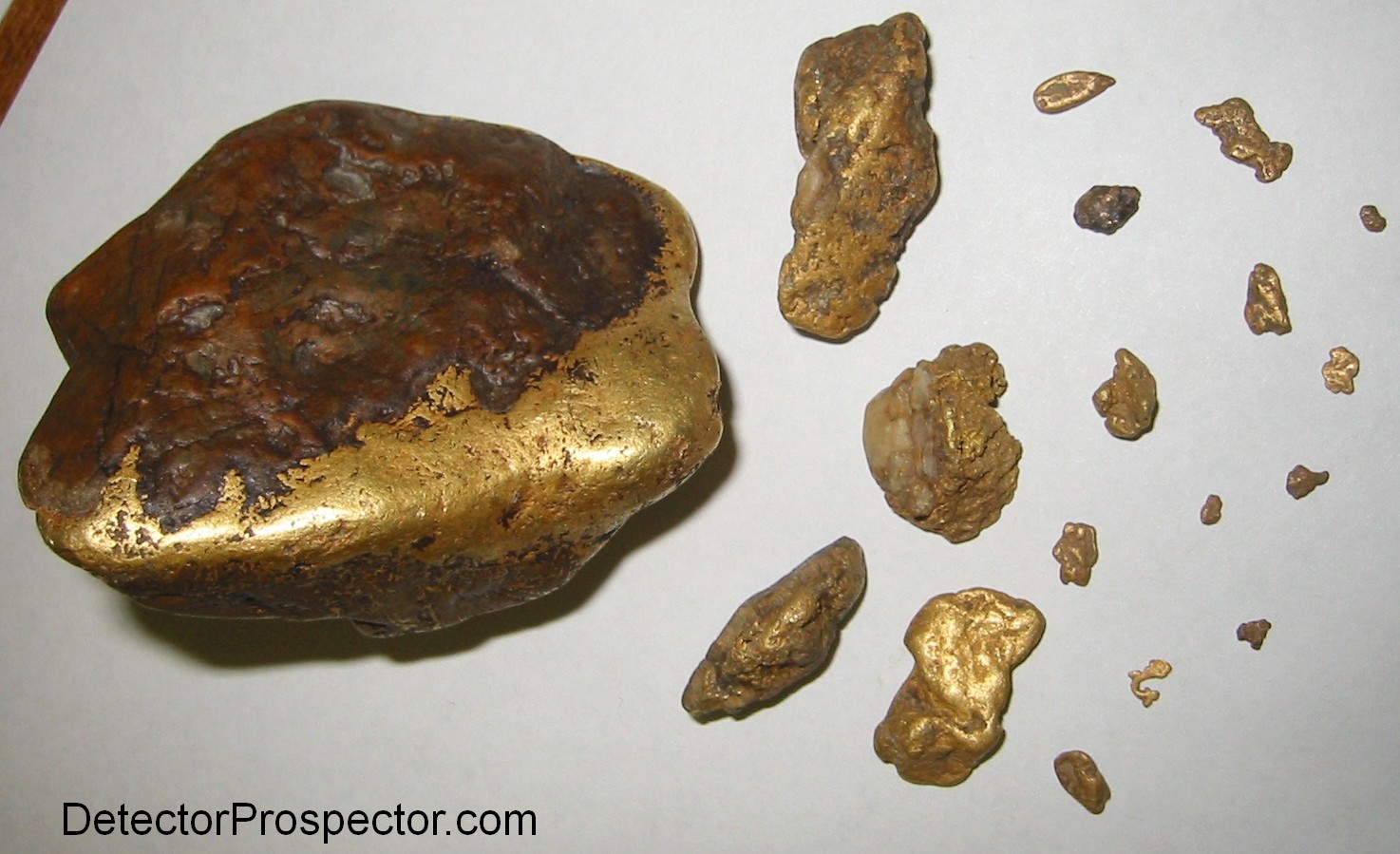
Steve's Gold - 8.15 Ounces Total
But the MXT does do very well on nuggets weighing a few grains or more, and the bigger the gold gets, the less difference there is between the MXT and GMT. Frankly, for nuggets weighing in pennyweights or more, I actually prefer the MXT. It operates smoother than the GMT in mineralized ground, and has depth as good as, and maybe under some circumstances better than, the GMT. It's a great machine for large nugget hunting.
Combine that with the fact that it has a vastly superior id system, with both iron readout and conductivity measurement, and you can actually do things like tell most gold nuggets from a .22 shell casing. I actually used the relic mode with the small coil on the MXT to work extreme trash areas to good effect. This machine has lots of potential to explore, and yet is very easy to use. Add in the the fact that it has a 6.5" x 4" elliptical DD, 5.3" round concentric, and 10" x 5.5" elliptical DD coils available as options, and I think the MXT is now the machine to beat for all-around use. And despite it's wealth of features, it's list price is only $799.95. I think we will be hearing a lot more about the MXT in coming years.
~ Steve Herschbach
Copyright 2002 Herschbach Enterprises






.thumb.jpg.8761b3d9b3da119b9e6d1912f67275ad.jpg)